This blog post explores the peculiar movements of Mars as observed by early astronomers, particularly focusing on Johannes Kepler's groundbreaking work in understanding planetary motion. It details the historical context, the challenges faced by astronomers, and Kepler's innovative approaches that ultimately led to a more accurate model of the solar system, despite initial setbacks.
Mars, the fourth planet from the Sun, has long fascinated astronomers due to its unusual movements across the night sky. Unlike the fixed stars, Mars appears to wander, moving from west to east against the backdrop of stars. This erratic behavior, particularly its retrograde motion, posed significant challenges for early astronomers and ultimately led to revolutionary changes in our understanding of the cosmos.
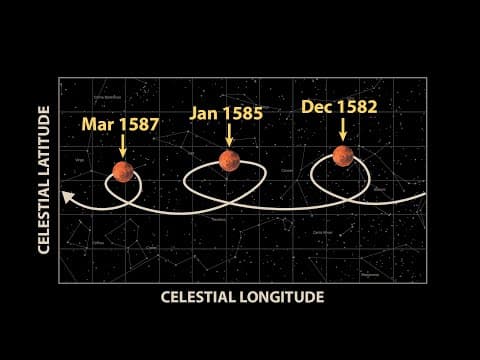
The term "planet" derives from the Greek word for "wanderer," aptly describing Mars's behavior. Early astronomers observed that the planet's movements varied depending on its proximity to the Sun. When Mars is close to the Sun, it rises and sets quickly, but as it moves further away, its motion becomes increasingly erratic. Mars can slow down, stop, and even move backward in the sky, creating retrograde loops that puzzled astronomers for centuries.
In the late 1500s, the astronomer Tycho Brahe dedicated over 20 years to collecting the most accurate astronomical data available. His meticulous observations of Mars revealed that the retrograde loops did not occur in the same position each time, and their shapes varied from cycle to cycle. This complexity raised questions about the underlying mathematical model of the solar system.
As Tycho lay dying in 1601, he implored his assistant, Johannes Kepler, to continue his work. Tycho believed that the motions of Mars and other planets could be explained by his geocentric model, where the Sun orbited a stationary Earth. However, Kepler had different ideas.
Six years before Tycho's death, Kepler experienced a significant breakthrough while lecturing. He noticed a mathematical pattern in the spacing of the planets, which he illustrated on a blackboard. This insight led him to propose that geometric shapes could represent the orbits of the planets. Although his initial model using 2D shapes did not yield accurate results, Kepler shifted to 3D platonic solids, which improved the fit but still fell short for Mercury and Jupiter.
Kepler recognized that the retrograde motion of Mars had been documented since ancient times, with models like the Ptolemaic system using epicycles to explain it. In this model, Mars would move in smaller circles (epicycles) while orbiting a larger circle centered on Earth. However, Kepler believed that a heliocentric model—placing the Sun at the center—could simplify the explanation.
In the heliocentric model, retrograde motion occurs when Earth, moving faster in its orbit, overtakes Mars. This perspective clarified why Mars appeared to move backward against the stars when it was in opposition to Earth.
Despite understanding the heliocentric explanation, Kepler faced a significant challenge: accurately predicting Mars's orbit. He realized that the variable speed of Mars was the primary source of error in existing models. To tackle this, he utilized Tycho's observations taken during oppositions, allowing him to analyze Mars's motion from a more direct perspective.
Kepler's analysis revealed that Mars's speed was not constant; it varied depending on its position in its orbit. He incorporated the concept of the equant, a point from which Mars's motion could be described as uniform, even though it deviated from the center of its orbit. This approach allowed him to refine his model significantly.
Through a painstaking process of trial and error, Kepler adjusted four parameters in his model: the distances between the Sun, Mars's orbit center, and the equant. After numerous iterations, he achieved a model that fit Tycho's observations with remarkable accuracy, yielding a maximum error of only 2 arc minutes.
Kepler's findings were groundbreaking, producing a model nearly 100 times more accurate than any previous attempts. However, he was aware that his model, while impressive, was still flawed.
In the spring of 1601, after a year of intense work, Kepler concluded that his model could not fully describe Mars's path. Following Tycho's death, he gained access to the complete dataset, freeing him from the constraints of Tycho's geocentric approach. This pivotal moment allowed Kepler to rebuild astronomy from the ground up, leading to the formulation of his three laws of planetary motion.
Kepler's journey illustrates the complexities of early astronomical studies and the evolution of our understanding of the solar system. His work not only reshaped astronomy but also laid the groundwork for future scientists to explore the cosmos with greater clarity and precision.