Despite the poetic notion that we are made of star-stuff, the origins of elements like gold remain a mystery. This blog explores the processes of element formation, including nuclear fusion and neutron capture, and discusses recent discoveries about neutron star mergers and magnetars that may contribute to the creation of heavy elements, including gold.
Carl Sagan once famously wrote, "We are made of star-stuff." While this statement is poetic, it oversimplifies the complex origins of elements in the universe. Not all elements are formed in stars, and some, like gold, have origins that remain elusive to scientists. This blog post delves into the processes that create elements, particularly focusing on the enigmatic journey of gold.
To understand where gold comes from, we first need to look at the Periodic Table. The lightest elements, such as hydrogen and helium, originated from the Big Bang. However, as we move to heavier elements, the story becomes more complicated.
Nuclear fusion is the process that powers stars. In this process, atomic nuclei collide at high speeds and fuse together, creating heavier elements. While fusion can produce elements up to iron, it has its limits. The most massive stars can create iron at the end of their life cycles, but they cannot produce elements heavier than iron through fusion alone.
For elements heavier than iron, scientists have identified a process called neutron capture. This process involves a seed nucleus that captures neutrons in an environment with a high neutron density. Neutrons, being neutral particles, can accumulate on a nucleus without repelling each other. However, these neutrons are unstable and eventually decay into protons, transforming the nucleus into a heavier element.
Neutron capture occurs in two main forms:
s-process (slow process): This occurs in low-mass red giant stars, where neutrons are added to the nucleus at a slower rate than they decay into protons. However, the s-process alone cannot account for all heavy elements in the universe.
r-process (rapid process): In contrast, the r-process occurs in environments with extremely high neutron densities, allowing neutrons to be added to the nucleus faster than they decay. This process is believed to happen in more extreme cosmic events.
For a long time, scientists speculated that supernovas might be the source of the r-process. However, evidence suggested that supernovas do not provide enough neutrons for the r-process to occur effectively. This led researchers to explore other possibilities, particularly neutron star mergers.
In 1974, astronomers proposed that neutron star mergers could create the ideal conditions for the r-process. Neutron stars, remnants of massive stars, are densely packed with neutrons. When two neutron stars collide, they create a powerful event that could facilitate the r-process.
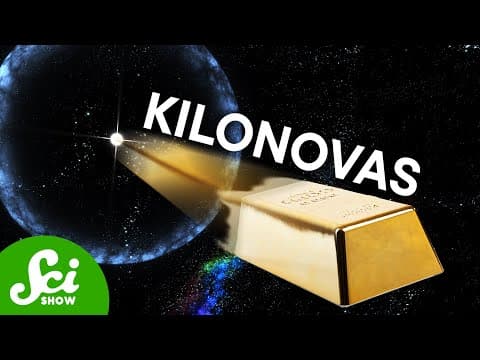
In 2017, the gravitational wave detectors LIGO and VIRGO captured an event known as GW170817, which was confirmed to be the merger of two neutron stars. This event produced a kilonova, a less bright but significant explosion that could indicate the presence of r-process elements, including gold.
Following the detection of GW170817, astronomers observed kilonova AT2017gfo, which emitted light that could be analyzed for chemical signatures. While they found evidence of other r-process elements, the signature of gold was notably absent. This raised questions about the actual production of gold in such cosmic events.
Despite the potential for neutron star mergers to produce gold, scientists have not yet found definitive evidence of gold in the kilonova light. Some studies suggest that a significant amount of gold could have been produced during the merger, but it remains undetected. Estimates indicate that the merger could have created up to 3000 Earth’s worth of gold, yet this amount is still not enough to explain the total gold present in the universe.
With the mystery of gold's origin still unresolved, scientists are exploring other possibilities:
The quest to understand where gold and other heavy elements come from continues. While we can confidently say that we are made of star-stuff, the origins of elements like gold remain a cosmic mystery. As our observational capabilities improve and new theories emerge, we may one day uncover the secrets of the universe's heavy elements. Until then, the search for the origins of gold and other elements beyond iron continues, reminding us of the complexity and wonder of the cosmos.