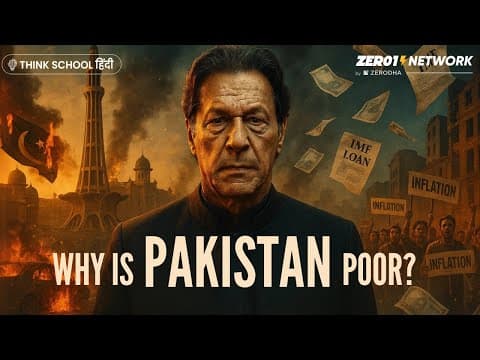
This blog post explores the economic decline of Pakistan, contrasting its past potential with its current struggles. It examines the impact of military rule, political instability, and misguided geopolitical alliances on the country's economy, drawing lessons for other nations, particularly India.
When people think of Pakistan today, they often associate it with terrorism, poverty, and political turmoil. Once considered a potential economic powerhouse in Asia, Pakistan now faces severe economic challenges, including high inflation and a reliance on foreign aid. This blog post delves into the factors contributing to Pakistan's economic decline and what lessons can be learned from its experience.
In the 1960s, Pakistan was viewed as a model for economic growth in Asia. The New York Times even suggested that Pakistan could achieve economic milestones comparable to those of the United States. In 1965, Pakistan was growing at an impressive rate of 6.8%, outpacing its neighbors like India and Sri Lanka. However, this promising trajectory has drastically changed over the decades.
Today, Pakistan is grappling with a dire economic situation. The country has had to rely on the International Monetary Fund (IMF) for bailouts multiple times, with the current crisis leading to widespread poverty and desperation among its citizens. The economic conditions have deteriorated to the point where many people struggle to afford basic necessities, leading to increased crime and social unrest.
One of the primary issues plaguing Pakistan's economy is the persistent military rule. Since gaining independence in 1947, Pakistan has experienced numerous military coups, with the army often exerting control over the government. This has resulted in a lack of stable democratic governance, which is crucial for economic development.
Both India and Pakistan gained independence in 1947, but their paths diverged significantly. While India established a stable democratic framework, Pakistan has seen its military intervene in politics repeatedly. Notably, no Prime Minister in Pakistan has completed a full five-year term since independence, leading to a cycle of instability.
The legal framework in Pakistan has also contributed to its political instability. The Doctrine of Necessity allows military leaders to justify their actions against the constitution if they claim it is necessary for the country's stability. This has led to a cycle of military takeovers and the erosion of democratic institutions.
Political instability has dire consequences for economic growth. Investors seek stable environments with clear regulations and long-term policies. In Pakistan, the military's control and political chaos deter foreign investment, leading to a stagnation in job creation and economic progress.
In contrast, India has attracted significant foreign investment from global brands like Apple, which has led to job creation and economic growth. The cycle of consumption and investment in India stands in stark contrast to Pakistan's economic struggles.
Pakistan's geopolitical decisions have also played a significant role in its economic decline. During the Cold War, Pakistan aligned itself with the United States, receiving military and financial support in exchange for its cooperation in the region. However, this relationship has been fraught with complications.
In the 1970s, as the Soviet Union invaded Afghanistan, the U.S. initiated Operation Cyclone, funneling billions of dollars in support to Afghan fighters through Pakistan. This led to the rise of extremist groups, including the Taliban and Al-Qaeda, which have since plagued Pakistan and the region.
The aftermath of the September 11 attacks in 2001 further complicated Pakistan's situation. The U.S. provided substantial aid to Pakistan, but the country was also accused of harboring terrorist groups. This duality of being a U.S. ally while simultaneously supporting extremist factions has damaged Pakistan's international reputation.
Today, Pakistan faces a multitude of economic challenges, including high inflation, a depreciating currency, and rising food insecurity. The government's reliance on foreign loans has only exacerbated these issues, leading to a cycle of debt and economic instability.
Recent political decisions, such as providing subsidies on electricity and fuel, have led to short-term popularity but long-term economic pain. These measures have strained the national budget and contributed to rising inflation, further impoverishing the populace.
The story of Pakistan offers several critical lessons for other nations, particularly India:
Pakistan's economic decline serves as a cautionary tale for nations striving for growth and stability. By learning from Pakistan's mistakes, particularly in governance and economic policy, other countries can work towards building a more stable and prosperous future. The lessons drawn from Pakistan's experience are not just relevant for its own citizens but also for neighboring countries like India, which must remain vigilant against similar pitfalls.