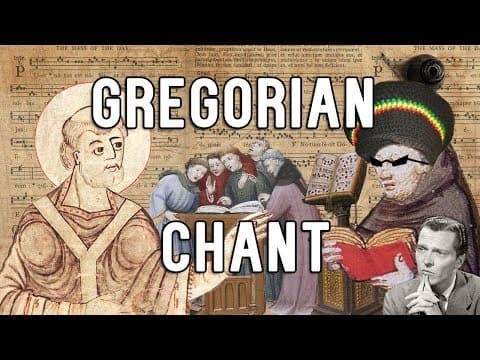
This blog post explores the history and evolution of Gregorian chant from its origins in the early Christian Church to its modern interpretations, highlighting key developments in notation, performance practices, and cultural significance.
Hello and welcome to Early Music Sources.com. Today, we will delve into the fascinating world of Gregorian chant, also known as plainchant. Often regarded as a foundational chapter in the history of Western music, Gregorian chant has persisted through the centuries, evolving while maintaining its core essence. In this post, we will highlight significant milestones in the story of Gregorian chant from the 9th century to the 20th century.
Singing has been integral to Christian liturgy since the Church's inception. However, the early repertoire was not standardized; each region had its own musical traditions. This lack of unity prompted efforts in the 8th century to create a cohesive canon of chants for the Christian world. According to legend, the Holy Spirit, in the form of a dove, sang the chants to Pope Gregory, who then recorded them. This mythological narrative is why only a specific subset of monophonic church chants is accurately termed "Gregorian."
Pope Gregory and his contemporaries lived in the 6th century, a time before the advent of musical notation. Thus, the transmission of music relied heavily on oral tradition and memory. This posed a significant challenge when attempting to share a vast repertoire across numerous institutions. By the 10th century, early forms of musical notation began to emerge, notably in a manuscript from the St. Gallen monastery in Switzerland, which introduced neumes—symbols indicating the number of notes per syllable and basic musical gestures.
The neumes in the St. Gallen manuscript served primarily as memory aids for those already familiar with the melodies. They lacked precise pitch information, making it difficult for novices to learn the music. As the need for more accurate notation grew, theorists began exploring various methods, but these were not widely adopted in liturgical chant books.
The breakthrough came with Guido d'Arezzo, who introduced a system that indicated the pitches of notes by marking the locations of F and C. This innovation allowed for sight-reading, enabling individuals unfamiliar with the music to learn it independently. The evolution of notation continued into the 13th century, where manuscripts began to use more substantial square notations, paving the way for future developments.
The 16th century brought significant changes to Gregorian chant, particularly influenced by the Council of Trent during the Counter-Reformation. The council criticized the clarity of sung texts, leading to reforms aimed at enhancing comprehensibility. Pope Gregory XIII commissioned Giovanni Pierluigi da Palestrina to oversee these reforms, resulting in new chant books that included note values to better reflect the accents of the text.
In the mid-17th century, the Neo-Gallican movement emerged in France, which sought to create a distinct style of plainchant. This movement produced newly composed chants in the Gregorian style and incorporated modern notational techniques, including detailed tempo instructions and improvisational practices.
The 19th century saw a revival of interest in Gregorian chant, particularly through the efforts of the Benedictine monks of Solesmes. They believed that contemporary editions of the chants were corrupted and sought to reconstruct the original versions. Utilizing photography to publish facsimile editions of ancient manuscripts, their work culminated in Pope Pius X approving their restored chants in 1903.
The editions produced by the monks of Solesmes established a hybrid notation system based on earlier manuscripts, which significantly influenced how Gregorian chant is understood and performed today. Their approach emphasized practical performance, leading to a standardized interpretation of the chants that persists into the modern era.
The journey of Gregorian chant from the Middle Ages to the present day is a testament to its enduring legacy. Each generation has contributed to its evolution, making it a rich and complex tradition. The insights shared in this exploration highlight the significance of Gregorian chant not only in music history but also in the cultural and spiritual life of the Church. Thank you for joining us on this journey through time, and we look forward to sharing more insights in future posts.