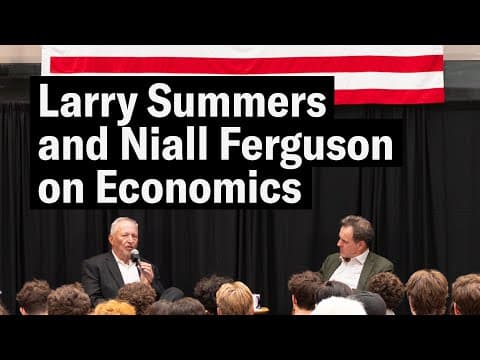
In a conversation between Larry Summers and Niall Ferguson, they discuss the state of economics, the implications of tariffs, the role of AI in the economy, and the challenges of fiscal policy. Summers argues against the notion of economic decline, emphasizes the importance of models in economics, critiques current tariff policies, and highlights the transformative potential of AI.
In a recent conversation, economists Larry Summers and Niall Ferguson explored the current state of economics, the implications of tariffs, and the transformative potential of artificial intelligence (AI) in the economy. Their discussion provided valuable insights into the challenges and opportunities facing the discipline today.
The conversation began with a provocative question: Is economics a discipline in intellectual decline? Summers firmly disagreed, arguing that the ability of economists to make accurate forecasts has improved over time. He noted that while predicting specific events remains challenging, the overall quality of economic forecasts has trended upwards, as evidenced by a decrease in the average size of forecasting errors.
Summers pointed out that the field of economics has expanded significantly, with economists now playing crucial roles in various government agencies, including the Environmental Protection Agency (EPA) and the Justice Department. He emphasized that economics has become increasingly influential in shaping public policy and that its methodologies have been adopted by other social sciences.
A significant part of the discussion focused on the use of models in economics. Summers explained that all thought processes rely on models, whether they are explicit mathematical models or implicit subjective ones. He acknowledged that while quantitative models can sometimes fail, they allow for adjustments and improvements when errors are identified.
He criticized the Federal Reserve's model for being outdated and not adequately reflecting the current economic landscape. However, he maintained that this critique should not be seen as a fundamental flaw in the discipline of economics itself.
The conversation shifted to the topic of tariffs, particularly in light of recent policy changes proposed by the Trump administration. Summers described the imposition of tariffs as a self-imposed supply shock that would lead to higher prices for consumers, reduced purchasing power, and increased unemployment. He argued that such policies are fundamentally flawed, as they do not consider the broader economic implications and could invite retaliation from other countries.
Summers highlighted the fact that a significant portion of American imports are inputs for exports, suggesting that tariffs could harm American exporters more than they help domestic producers. He expressed concern about the uncertainty created by fluctuating tariff policies, which could lead to delayed investments and economic stagnation.
Ferguson raised the issue of China's economic practices, particularly its alleged unfair competition and subsidies. Summers responded by challenging the framing of the issue as one of "cheating." He argued that if China offers goods at lower prices, it benefits consumers and should not be viewed negatively. He acknowledged the complexities of dealing with potential predatory pricing but emphasized that the focus should be on fostering competition rather than imposing tariffs.
The discussion also touched on fiscal policy, with Summers warning that the U.S. cannot sustain a fiscal deficit above 6% of GDP indefinitely. He suggested that addressing the fiscal problem would require either cutting benefits or raising taxes, emphasizing the need for a realistic approach to public finance. He pointed out that enforcing tax laws could significantly increase revenue without raising taxes, highlighting the importance of effective governance.
As the conversation progressed, the potential impact of AI on the economy became a focal point. Summers expressed optimism about AI's ability to drive economic growth, suggesting that it could lead to a new industrial revolution. He noted that while AI's immediate effects might not be apparent, its long-term implications could be profound, potentially accelerating scientific progress and transforming productivity.
Summers cautioned that while AI holds great promise, it is essential to approach its integration into the economy thoughtfully, considering both the opportunities and challenges it presents.
In conclusion, the conversation between Larry Summers and Niall Ferguson provided a comprehensive overview of the current state of economics, the implications of tariffs, and the transformative potential of AI. Summers' insights challenged the notion of economic decline, emphasized the importance of models, and highlighted the need for thoughtful fiscal policies. As the economy continues to evolve, the role of economists will be crucial in navigating the complexities of modern economic challenges.