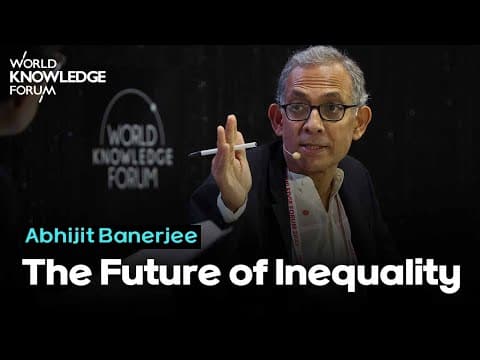
Abhijit Banerjee discusses the alarming rise of inequality globally, its historical context, and the implications of economic policies on social mobility and wealth distribution. He emphasizes the need for policy reforms to address the growing divide and the impact of technology and education on future inequality.
In a recent session moderated by Professor Yun Hang, Abhijit Banerjee, a renowned economist and Nobel laureate, shared his insights on the pressing issue of inequality. As the Ford Foundation International Professor of Economics at MIT, Banerjee's work has significantly influenced the field of development economics, particularly through his pioneering use of randomized controlled trials to evaluate policies aimed at alleviating poverty. This blog post summarizes his key points regarding the current state and future of inequality.
Banerjee began by highlighting that many countries, including China, India, Japan, the United States, and South Korea, are experiencing unprecedented levels of inequality. He noted that the income ratio between the top 10% and the bottom 50% is at historical highs, a trend that has persisted since the early 1980s. This rise in inequality is not uniform across all nations; for instance, countries like Brazil, Nigeria, and Indonesia have seen stable or declining inequality levels despite their historical challenges with wealth distribution.
Banerjee pointed out that the significant shift in inequality began around 1980, coinciding with major political changes in the US and UK, such as the election of Ronald Reagan and Margaret Thatcher. These leaders implemented policies that drastically reduced tax rates for the wealthy, legitimizing high salaries for CEOs and contributing to the widening income gap. The ideological shift towards viewing inequality as a necessary component for economic growth further entrenched this divide.
A critical aspect of Banerjee's argument is the debunking of the notion that inequality drives economic growth. He presented evidence showing that countries with higher levels of inequality do not necessarily experience faster growth. In fact, the correlation between changes in inequality and economic growth is weak, suggesting that increasing inequality does not promote overall economic health.
Banerjee emphasized the alarming concentration of wealth among the top 1% and the top 1,000 individuals globally. Their income growth has outpaced that of the broader population, leading to monopolistic practices that stifle competition and innovation. This concentration of wealth not only exacerbates inequality but also negatively impacts productivity growth.
The rise in inequality has significant political ramifications. Banerjee noted that regions with stagnant wage growth have seen a rise in populist sentiments, as individuals seek solutions to their economic struggles. This political landscape is shaped by the frustrations of those left behind in an increasingly unequal society.
Banerjee discussed the implications of artificial intelligence (AI) on the labor market, particularly for middle-skilled workers. As AI technology advances, it threatens to displace jobs that are crucial for the middle class, while potentially benefiting lower-skilled workers in sectors like healthcare. The rising costs of elite education further exacerbate inequality, as access becomes increasingly limited to the wealthy.
To address the growing inequality, Banerjee proposed several policy measures:
Banerjee concluded his talk with a call to action, urging the audience not to lose hope in the face of rising inequality. He emphasized the importance of creativity and collaboration in finding solutions to these pressing issues. As the world grapples with the challenges of inequality, it is crucial for policymakers, economists, and citizens alike to engage in meaningful dialogue and action to foster a more equitable future.