This blog post explores the economic turmoil and recovery efforts in various countries between World War I and World War II, focusing on Germany's hyperinflation, the Soviet Union's economic policies under Lenin and Stalin, and the impact of the Great Depression on global economies.
The aftermath of World War I was not a period of peace and prosperity, but rather a time of significant economic turmoil that set the stage for World War II. This blog post delves into the economic crises faced by various nations during this period, particularly focusing on Germany, the Soviet Union, and the United States.
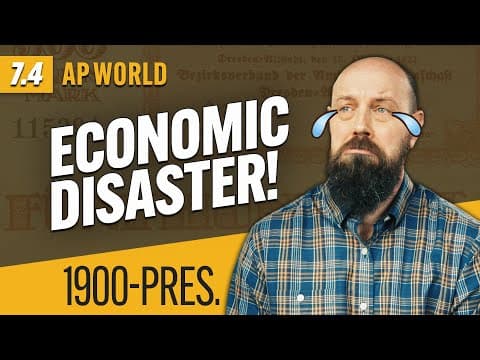
Following the Treaty of Versailles, Germany was burdened with heavy reparations payments, which contributed to its economic downfall. The German government, facing immense debt and the inability to pay reparations, resorted to printing more money. This decision led to hyperinflation, devastating the economy.
To illustrate the severity of the situation, consider this: in 1922, a loaf of bread cost 160 marks, but by November 1923, that same loaf cost 200 billion marks. The value of the German Mark plummeted, and by the end of 1923, one US dollar could be exchanged for 4.2 trillion marks. This hyperinflation not only affected Germany but also had ripple effects on other nations, particularly Britain and France, which struggled to repay their own war debts to the United States.
In contrast to Germany, the Soviet Union, having exited World War I during the Russian Revolution, faced its own economic challenges. Under Vladimir Lenin, the New Economic Policy (NEP) was introduced in 1923, allowing for limited free market principles while maintaining state control over major industries.
Lenin's death in 1924 led to Joseph Stalin's rise to power, who sought rapid industrialization through a series of Five-Year Plans. These plans aimed to significantly increase industrial capacity but required a strong state intervention. To support industrial growth, Stalin implemented the collectivization of agriculture, merging small farms into large state-owned collectives.
This policy faced fierce resistance from the kulaks, the wealthy landowning class, leading to their arrest and execution. The resulting agricultural decline, particularly in Ukraine, caused widespread famine known as the Holodomor, where millions starved due to the state's prioritization of urban workers over rural farmers.
While many countries struggled, the United States initially enjoyed a booming economy. However, the stock market crash of 1929 plunged the nation into the Great Depression, which had global repercussions. European economies, reliant on American investments for post-war recovery, were severely impacted by the U.S. economic downturn.
In response to the Great Depression, President Franklin D. Roosevelt implemented the New Deal, a series of government-sponsored programs aimed at economic recovery. These initiatives included infrastructure projects, retirement programs, and medical insurance for the elderly and children. While the effectiveness of the New Deal is debated, it marked a significant shift in government involvement in the economy.
The period between the World Wars was marked by economic instability and recovery efforts that varied greatly from country to country. Germany's hyperinflation, the Soviet Union's drastic economic policies under Stalin, and the United States' response to the Great Depression all illustrate the complex interplay of economic forces during this tumultuous time. As nations struggled to recover, the groundwork was laid for the next global conflict, highlighting the fragility of economic stability in the face of political and social upheaval.