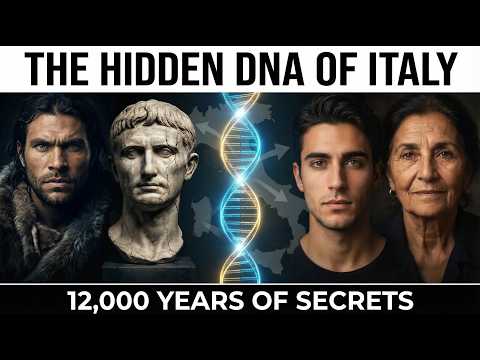
Italy's genetic history spans 12,000 years, shaped by Ice Age hunter-gatherers, Neolithic farmers from Anatolia, Bronze Age steppe herders, and various ancient and medieval migrations. Modern Italians carry a rich tapestry of genetic lineages reflecting survival, migration, and cultural evolution, making Italy a living archive of human history and diversity.
When you think of Italy, images of beauty, art, food, passion, and history come to mind. Yet beneath the cobblestones of Rome and the vineyards of Tuscany lies a story rarely told — a story written not in marble or fresco, but in DNA.
Over the past two decades, the science of ancient genomics, which extracts and reads genetic material from thousand-year-old bones, has revolutionized our understanding of the origins of the Italian people. The truth uncovered is stranger, richer, and more surprising than any myth or legend.
To understand the genetic makeup of Italians, we must travel back to a time before Italy existed as a nation. Around 20,000 years ago, during the last glacial maximum, much of Europe was covered in ice. Human populations were forced into small, warmer refuges — notably the Iberian Peninsula, the Balkans, and the Italian Peninsula itself.
Italy served as one of the great refugia of Ice Age Europe, a sanctuary where humans survived when much of the continent was uninhabitable. These people, known as western hunter-gatherers, have left extraordinary genetic legacies.
These ancient Italians were not the stereotypical pale Europeans. Genetic analysis suggests they likely had dark brown skin, a trait inherited from recent African ancestors, but many had blue or green eyes — some of the earliest known appearances of light eye color in Europe. Physically, they were tall, lean, and mobile, hunting deer and wild boar, fishing rivers and coastlines, and leaving behind cave art and burial rituals indicative of rich symbolic lives.
As glaciers retreated around 12,000 years ago, these hunter-gatherers spread across Europe, including the warming Italian peninsula, remaining the dominant population for thousands of years.
Around 8,000 to 9,000 years ago, a revolution began in present-day Turkey and the Fertile Crescent: the advent of farming. Early European farmers domesticated crops and livestock and expanded westward by boat, bringing new genetic lineages to Italy.
When these farmers encountered native hunter-gatherers, they did not wipe them out but mixed with them. However, agriculture supported larger populations, so farmer ancestry eventually dominated, diluting but not erasing hunter-gatherer genetics.
Today, Anatolian Neolithic ancestry remains visible in modern Italians, especially in southern Italy and Sardinia. Sardinians carry the highest proportions of Neolithic farmer ancestry in Western Europe, making them the closest living link to Europe’s first farmers.
About 5,000 years ago, a new wave of migration reshaped Europe. The Yamna people, nomadic herders from the grasslands north of the Black Sea, moved westward. They were early speakers of Proto-Indo-European and carried a genetic profile that profoundly influenced Europe.
Physically, they were taller and more robust than the farmers, likely due to a protein-rich pastoral diet and demanding lifestyle. Their skin tone was probably intermediate, darker than most northern Europeans today, with some carrying genes for blue or green eyes.
In Italy, the steppe influence varies regionally:
Maternal lineages brought by steppe populations include H subclades and U5A, a hunter-gatherer relic inherited by the steppe people themselves.
Culturally, these herders spoke the ancestor of Latin, the root of Italian, Spanish, French, Portuguese, and Romanian. Thus, when ordering an espresso in Rome, the words trace back to these Eurasian grasslands 5,000 years ago.
By 3,000 years ago, Italy was home to diverse peoples:
For centuries, the origins of the Etruscans were debated. Their unique, undeciphered language led some to speculate Anatolian origins, others to argue they were indigenous.
Ancient DNA studies reveal that Etruscans were overwhelmingly of local genetic stock, indistinguishable from neighboring Italian populations, showing no significant recent Anatolian migration. The Latins shared a similar genetic profile. Thus, their distinctiveness was cultural rather than genetic.
At its height, the Roman Empire stretched from Scotland to Mesopotamia and from the Sahara to the Rhine. People moved on an unprecedented scale — slaves, soldiers, merchants, and refugees.
Ancient DNA from Roman cemeteries shows a shift over time:
However, this data comes from urban Rome, a demographic exception due to its role as an empire hub and slave trade center. Rural Italy remained more genetically homogeneous.
Imperial Rome was one of the most genetically diverse cities of the ancient world. Whether this diversity left lasting traces in modern Italians remains an open question.
The fall of the Western Roman Empire brought new genetic influences:
Lombards: Germanic warriors from the north conquered much of Italy in 568 AD. Ancient DNA confirms their northern European origins (R1BU106 and I1 haplogroups). As a ruling minority, their genetic impact was modest, mostly detectable in isolated Alpine communities.
Sicily: A complex genetic story with Arab conquest in the 9th century introducing J1 and E1B1B lineages from North Africa and the Levant, still detectable today, especially in western Sicily. Later, Norman descendants of Norse Vikings brought R1B and I1 haplogroups, but their genetic contribution was limited.
Each migration layer is real but more modest in genetic impact than dramatic historical narratives might suggest.
The paternal haplogroup distribution in modern Italy reflects this complex history:
This north-south genetic gradient is real and measurable, shaped by geography, history, and thousands of years of differential migration patterns, not by any intrinsic cultural or national differences.
It is important to understand that haplogroups represent only a single line of descent — your direct paternal lineage. They are just one thread in a vast tapestry and do not define the entirety of your genome, which comes from hundreds of ancestral lines.
For example, a man carrying R1B descends from steppe-related populations on one paternal line but may carry substantial Neolithic farmer and hunter-gatherer ancestry in his full genome.
Modern Italians are shaped by a mixture of:
They are a living archive of human history.
Italian culture’s universal and generative nature reflects its deep genetic roots made by all of humanity. The next time you enjoy Italian art, cuisine, or language, remember the 12,000 years of migration, survival, love, conquest, and human drive to move and create that lie behind the word "Italian."
This story is not just Italy’s — it is all of ours.