The Michelson-Morley Experiment and the Foundations of Special Relativity Explained
This article explores the solutions to Maxwell's equations in vacuum, the nature of electromagnetic waves, and the historic Michelson-Morley experiment that challenged the existence of the ether. It culminates in the introduction of Einstein's special relativity postulates, which revolutionized our understanding of space, time, and the constant speed of light in all inertial frames.
In the previous lecture, we discussed Maxwell's equations, which describe the behavior of electric and magnetic fields in the presence of sources. Today, we focus on solutions to these equations in vacuum, where there are no charges or currents, to understand the nature of electromagnetic waves and their implications.
Maxwell's equations in vacuum can be written with the constants ( \epsilon_0 ) and ( \mu_0 ), which define the speed of light ( c ) through the relation ( c = \frac{1}{\sqrt{\epsilon_0 \mu_0}} ).
The key vector calculus operations involved are divergence, gradient, and curl. Using these, we analyze the behavior of the electric field ( \mathbf{E} ) and magnetic field ( \mathbf{B} ) as functions of space and time.
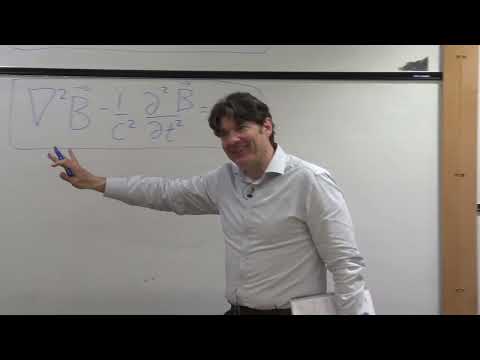
Using vector identities and Maxwell's equations, we derive the wave equation for the electric field:
[ \nabla^2 \mathbf{E} - \frac{1}{c^2} \frac{\partial^2 \mathbf{E}}{\partial t^2} = 0 ]
Similarly, the magnetic field ( \mathbf{B} ) satisfies the same wave equation. This is a fundamental result showing that electromagnetic fields propagate as waves at speed ( c ).
A common solution to the wave equation is the plane wave:
[ f(\mathbf{r}, t) = f(\mathbf{k} \cdot \mathbf{r} - \omega t) ]
where ( \mathbf{k} ) is the wave vector, ( \omega ) is the angular frequency, and ( \mathbf{r} ) is the position vector. The relation ( \omega^2 = c^2 |\mathbf{k}|^2 ) must hold.
These plane waves represent surfaces of constant phase moving in the direction of ( \mathbf{k} ) at speed ( c ).
For electromagnetic waves, the electric and magnetic fields can be expressed as:
[ \mathbf{E} = \mathbf{E}_0 e^{i(\mathbf{k} \cdot \mathbf{r} - \omega t)}, \quad \mathbf{B} = \mathbf{B}_0 e^{i(\mathbf{k} \cdot \mathbf{r} - \omega t)} ]
where ( \mathbf{E}_0 ) and ( \mathbf{B}_0 ) are constant vectors. From Maxwell's equations, it follows that:
- ( \mathbf{E}_0 ) and ( \mathbf{B}_0 ) are perpendicular to ( \mathbf{k} ).
- ( \mathbf{E}_0 ) and ( \mathbf{B}_0 ) are perpendicular to each other.
- The magnitudes satisfy ( B_0 = \frac{1}{c} E_0 ).
This means electromagnetic waves are transverse waves with electric and magnetic fields oscillating perpendicular to the direction of propagation and to each other.
These solutions correspond to light waves. By measuring ( \epsilon_0 ) and ( \mu_0 ) independently, the speed ( c ) calculated matches the known speed of light ( 3 \times 10^8 ) m/s.
Maxwell's theory successfully explains all classical laws of optics, such as reflection and refraction, from fundamental electromagnetic principles.
Historically, waves were understood to require a medium to propagate, like sound waves in air or water waves in water. Physicists postulated the existence of a medium called the "ether" filling all space, through which light waves propagate.
The ether was thought to be stationary, and the speed of light ( c ) was measured relative to this ether.
Light can also be described as particles called photons, which move at speed ( c ). Quantum mechanics relates the energy of a photon to its frequency by:
[ E = \hbar \omega ]
where ( \hbar ) is the reduced Planck constant.
If the Earth moves through the ether at velocity ( v ), the speed of light measured on Earth should vary depending on the direction of measurement.
Michelson and Morley designed an interferometer experiment to detect differences in the speed of light along two perpendicular arms of length ( L ).
- One beam travels along the direction of Earth's motion (blue path).
- The other beam travels perpendicular to it (red path).
They calculated the expected time differences for light to travel these paths considering Earth's velocity relative to the ether.
- For the beam along the motion, the time to go and return is affected by the relative motion, resulting in different effective speeds ( c - v ) and ( c + v ).
- For the perpendicular beam, the light travels a longer diagonal path due to the motion of the apparatus.
The expected difference in travel times would cause a shift in the interference pattern when the apparatus is rotated.
Michelson and Morley observed no significant difference in the speed of light in any direction or due to Earth's motion.
This null result implied:
- The speed of light in vacuum is constant and independent of the motion of the source or observer.
- The ether, as a medium for light propagation, does not exist.
This result contradicted classical Newtonian mechanics and Galilean relativity, which assumed velocities add linearly and that there is an absolute frame of reference.
Albert Einstein proposed a new framework, special relativity, based on the following postulates:
- The laws of physics are the same in all inertial frames.
- The speed of light in vacuum is constant and independent of the motion of the source or observer.
These postulates led to revolutionary changes in our understanding of space and time, including:
- Abandoning the ether concept.
- Modifying the addition of velocities.
- Recognizing that mass is not conserved in the classical sense.
The Michelson-Morley experiment was a pivotal moment in physics, demonstrating the constancy of the speed of light and challenging existing notions of absolute space and time.
Maxwell's equations predict electromagnetic waves traveling at speed ( c ), and the failure to detect the ether led to the development of Einstein's special relativity, fundamentally altering our conception of the universe.
Future lectures will build upon these postulates to explore the full implications of special relativity.