This blog explores the life and theories of Dr. Bentov, who proposed a holographic view of reality and consciousness. His work, which intersected with CIA interests, suggests that human perception can be influenced and manipulated. The implications of his findings resonate with modern technology and intelligence operations, raising questions about control and reality.
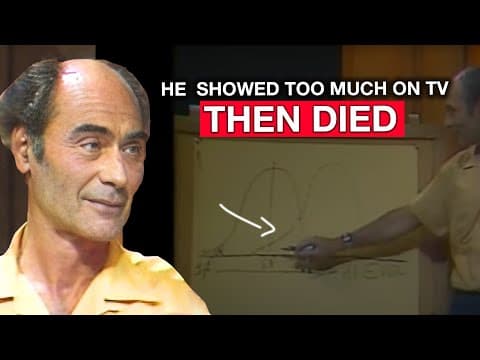
In the realm of consciousness studies, few figures stand out like Dr. Bentov, a pioneer who proposed radical ideas about the nature of reality and human perception. His theories, which suggest that our understanding of reality is far more complex than it appears, have not only intrigued scientists but also caught the attention of intelligence agencies like the CIA. This blog delves into Bentov's groundbreaking work, his untimely death, and the eerie connections between his theories and classified government projects.
Dr. Bentov's work revolved around the concept of a non-physical reality, where different layers of existence overlap. He described a universe akin to a hologram, where every fragment contains the whole picture. This perspective challenges the conventional view of separate physical entities, suggesting instead that at higher levels of consciousness, everything is interconnected.
Bentov illustrated his ideas through diagrams that depicted various levels of existence:
This layered understanding of reality implies that our perception is limited by our physical senses, which only capture a fraction of the universe's vastness.
Bentov's exploration didn't stop at the mind; he also examined how the heart and brain interact with the cosmos. He discovered that the heartbeat sends rhythmic waves up the spine to the brain, creating oscillations that synchronize with the body's electromagnetic field. These oscillations, he argued, resonate with frequencies found throughout nature, suggesting a cosmic feedback loop.
For Bentov, meditation was not merely a practice for relaxation but a method to tune the heart-brain system to resonate with the universe. He believed that through proper meditation techniques, individuals could expand their perception and experience reality as a seamless whole. This idea was revolutionary, proposing that the human body is a finely tuned instrument capable of accessing deeper layers of consciousness.
In 2003, a CIA document titled "Gateway Process" surfaced, revealing the agency's interest in altered states of consciousness. This report echoed many of Bentov's theories, discussing the brain and body as oscillating systems and the potential for consciousness to extend beyond conventional boundaries.
The Gateway document suggested that mastering certain techniques could enable remote viewing—perceiving events without physical presence. This concept aligns closely with Bentov's ideas about consciousness and reality, raising questions about why the CIA would invest in such research. The implications of these findings suggest that understanding and manipulating perception could be a strategic asset.
The CIA's exploration of perception control didn't stop with Bentov's theories. Other classified projects revealed methods for influencing individuals without their conscious awareness. Techniques included:
These methods highlight a disturbing reality: perception can be engineered, allowing for manipulation at a fundamental level.
A former US Navy interrogator, Hughes, emphasized the power of confusion in persuasion. By overwhelming a target with contradictions, the brain becomes susceptible to suggestion. This technique can create parallel realities within populations, where individuals perceive the same physical world yet inhabit entirely different mental landscapes.
In today's digital landscape, the principles of perception control have evolved. Platforms like Google and social media utilize algorithms that predict user behavior, shaping narratives and influencing opinions before individuals even realize it. This predictive feedback loop allows for subtle shifts in perception, making it increasingly difficult to discern engineered influence from organic thought.
Dr. Bentov's exploration of reality and consciousness offers profound insights into the nature of existence and the potential for human perception to be manipulated. The connections between his work and CIA projects reveal a complex interplay between science, consciousness, and control. As we navigate an increasingly digital world, understanding these dynamics becomes crucial in discerning the reality we inhabit and the forces that shape it. The question remains: if reality can be bent through perception, who truly controls our understanding of it?