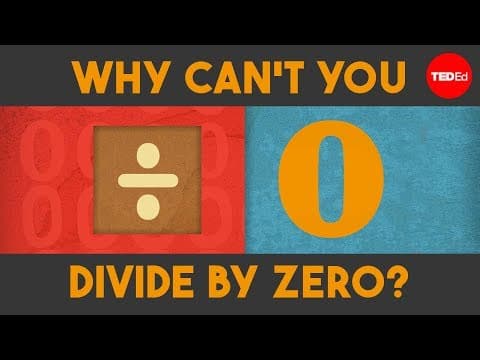
Dividing by zero is a mathematical conundrum that leads to contradictions and undefined results. While dividing by smaller numbers yields larger results, dividing by zero does not yield infinity due to the absence of a multiplicative inverse for zero. Attempts to redefine this concept lead to paradoxes, illustrating the complexities of mathematical rules.
In the world of mathematics, there are many strange results that can occur when we change the rules. However, one rule that most people have been cautioned against breaking is the prohibition against dividing by zero. This seemingly simple operation raises profound questions about the nature of numbers and mathematical operations.
To grasp why dividing by zero is problematic, we first need to understand what division means. For instance, when we say ten divided by two, we can interpret this as asking how many times we must add two together to reach ten. Alternatively, we can think of it as determining what number multiplied by two equals ten.
In essence, division is the reverse of multiplication. If we multiply any number by a given number x, we can ask if there exists another number that we can multiply by afterwards to return to our original number. This new number is known as the multiplicative inverse of x.
For example, if we multiply three by two to get six, we can then multiply by one-half to return to three. Thus, the multiplicative inverse of two is one-half, and the multiplicative inverse of ten is one-tenth. A key property of these inverses is that the product of any number and its multiplicative inverse is always one.
When we attempt to divide by zero, we seek to find its multiplicative inverse, which would be one over zero. This would imply the existence of a number that, when multiplied by zero, yields one. However, since any number multiplied by zero is still zero, such a number cannot exist. Therefore, zero has no multiplicative inverse, which is a fundamental reason why dividing by zero is undefined.
Despite the clear reasoning against dividing by zero, mathematicians have historically challenged established rules. For instance, the concept of taking the square root of negative numbers was once deemed impossible until mathematicians introduced the imaginary unit i, leading to the development of complex numbers. This raises the question: could we redefine division by zero in a similar manner?
Let’s entertain the idea of defining infinity as one over zero. If we proceed with this assumption, we would conclude that zero times infinity must equal one. Following this logic, zero times infinity plus zero times infinity should equal two. By applying the distributive property, we can rearrange the left side of the equation to zero plus zero times infinity, which simplifies to zero times infinity.
However, we previously defined zero times infinity as equal to one, leading us to the contradictory conclusion that one equals two. While this may not be inherently wrong, it is certainly not true within the conventional framework of numbers. The only scenario where this could hold true is if all numbers, including one and two, were equal to zero, which is not a practical or useful concept in mathematics.
Interestingly, there exists a mathematical construct known as the Riemann sphere that addresses the concept of dividing by zero through a different methodology. However, this is a complex topic that warrants its own discussion.
In summary, dividing by zero in the most straightforward manner leads to contradictions and undefined results. While it is tempting to experiment with breaking mathematical rules to explore new concepts, the traditional understanding of division and the properties of numbers provide a solid foundation for why dividing by zero is not feasible. Nevertheless, the pursuit of knowledge and the willingness to challenge established norms can lead to exciting discoveries in the world of mathematics.