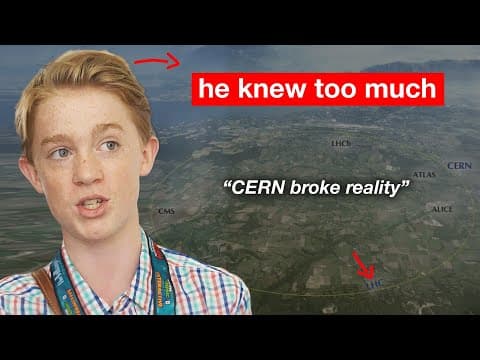
In 2008, CERN's Large Hadron Collider sparked theories about parallel universes and reality shifts, popularized by Max Loen, a genius kid who vanished after claiming the collider altered our universe. This article explores the Mandela Effect, quantum physics, and philosophical ideas about infinite realities, consciousness, and altered timelines, revealing a complex view of existence and the nature of reality.
In 2008, the European Organization for Nuclear Research (CERN) launched the Large Hadron Collider (LHC), the most powerful particle accelerator ever built. Its purpose was to smash atoms at near light speed to uncover the fundamental code of the universe. However, shortly after its activation, strange phenomena began to emerge, sparking theories about parallel universes and shifts in reality.
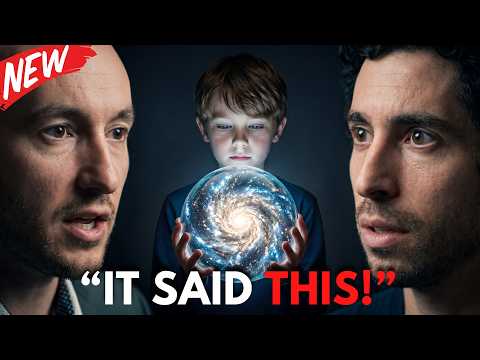
One of the most intriguing figures in this narrative is Max Loen, a young prodigy who claimed that the LHC had altered the weight of an electron, effectively destroying our universe and shifting us into a parallel one. After making these claims on live TV, Max mysteriously disappeared, leaving the internet searching for answers.
This article delves into Max's theories, the Mandela Effect, and the scientific and philosophical ideas surrounding parallel universes and the nature of reality.
The Large Hadron Collider began operations in 2008, and by 2009, people started noticing discrepancies in their memories compared to reality. This phenomenon became known as the Mandela Effect, named after the widespread false memory of Nelson Mandela dying in prison in the 1980s, when in fact he passed away in 2013.
Thousands of people shared similar false memories involving logos, movie lines, and historical events. Max Loen theorized that the LHC had caused a shift into a parallel universe by altering the weight of a single electron, which led to an infinite number of parallel universes being created.
After his initial viral video, Max reappeared to present a device he claimed could convert waste electromagnetic energy into free electrical energy. While the validity of this device remains unproven, many inventors of similar "free energy" devices have faced ridicule or disappeared, possibly due to the threat such inventions pose to established industries.
Following this, Max and his family went silent for three years until a brief message appeared on his Facebook page in 2020, reassuring that he was alive and still passionate about building and inspiring change.
Max's ideas extend beyond the Mandela Effect. He proposed that reality is not fixed but constantly branching into infinite parallel universes with every particle vibration and decision. This aligns with the many-worlds interpretation of quantum mechanics, first proposed by physicist Hugh Everett in the 1950s, which suggests that all possible outcomes of quantum events exist simultaneously in separate universes.
Max described these universes as existing side by side, each slightly different, and that we are continuously shifting between them. This concept is supported by physicists and authors like Michael Talbot, who suggested that reality is a holographic projection with infinite variations.
Max also touched on the connection between consciousness and physics. He suggested that our senses perceive only a narrow range of reality, and some individuals experience an expanded perception that reveals more layers of existence. This phenomenon is sometimes mistaken for mental illness, such as schizophrenia, but may represent a premature evolutionary step in human consciousness.
Researcher Szak Bentov proposed that as the nervous system evolves, our perception of reality broadens, allowing us to experience more of the universe's total reality.
In 1977, writer Philip K. Dick proposed that our reality might have been rewritten or reprogrammed, creating an alternate world that people live in without realizing the change. This idea resonates with the Mandela Effect and the notion that reality is fluid and subject to alteration.
Dick used a metaphor of a patron of the arts whose servants continually replace or alter paintings on a wall, symbolizing how reality might be subtly changed without our awareness.
The stories of individuals like Max Loen, who speak about parallel realities and then vanish, raise questions about the nature of truth and existence. Whether coincidence or something more, these accounts challenge our understanding of reality.
If reality is indeed shifting and we are living in a new version without realizing it, it could explain the Mandela Effect and other unexplained phenomena.
The intersection of quantum physics, consciousness, and the Mandela Effect presents a fascinating, albeit complex, picture of reality. Max Loen's theories, though controversial and mysterious, echo long-standing scientific and philosophical debates about parallel universes and the nature of existence.
While definitive answers remain elusive, exploring these ideas encourages us to question our perceptions and remain open to the possibility that reality is far more intricate and dynamic than it appears.
This exploration into Max Loen's disappearance and the Mandela Effect invites us to consider the profound mysteries of the universe and our place within it.