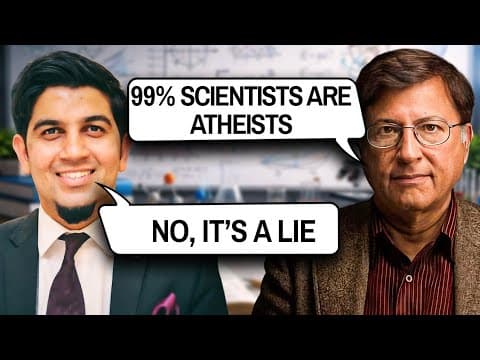
Contrary to claims that 99% of scientists are atheists, extensive research including a 2015 Rice University study of 9,422 scientists reveals that a significant portion identify with a religion. Historical figures like Newton and Einstein had religious beliefs or affiliations. Science and religion often coexist, providing complementary perspectives on ethics and meaning.
There is a widespread claim that 99% of scientists are atheists, a statement often repeated without substantial evidence. This article explores the truth behind this assertion by examining scientific studies, historical facts, and the relationship between science and religion.
Parvez Hoodbhoy, a prominent figure, has asserted that scientists are overwhelmingly religionless, stating that 99% of scientists have no religious affiliation. He claims to have based this on studies where scientists were asked about their religious beliefs. However, upon closer inspection, no such definitive study supporting this claim has been found by critics.
The most comprehensive study on this topic was conducted by Rice University in 2015, led by Professor Elaine Howard Ecklund. This study surveyed 9,422 scientists across eight regions and included interviews with 69 scientists. The findings contradict Hoodbhoy's sweeping statement:
These results indicate that a significant number of scientists maintain religious beliefs or affiliations.
Additional studies reinforce these findings:
Many renowned scientists throughout history were religious or had spiritual beliefs:
These examples illustrate that science and religion have often coexisted and influenced each other.
The notion that science and religion are inherently in conflict is not universally accepted. According to the Rice University study, only a minority of scientists perceive a conflict between the two. Religion often provides a framework for ethics, meaning, and purpose, while science offers methods to understand and improve the material world.
The claim that 99% of scientists are atheists is not supported by empirical evidence. Large-scale studies show that many scientists maintain religious beliefs or affiliations. Historical figures in science often had deep religious convictions. Science and religion can coexist, each addressing different aspects of human experience. It is important to avoid sweeping generalizations and to recognize the nuanced relationship between faith and scientific inquiry.