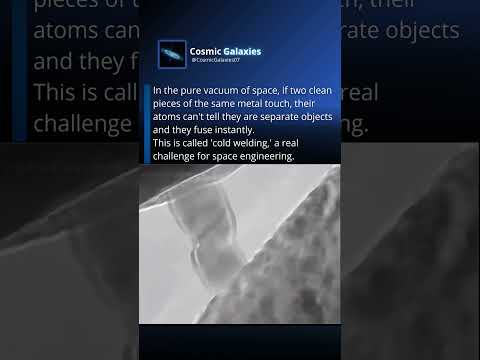
In the vacuum of space, two clean pieces of the same metal can fuse together instantly due to a phenomenon known as cold welding. This poses significant challenges for space engineering, as it can lead to unintended consequences for spacecraft and tools.
In the vast expanse of space, where the environment is drastically different from that on Earth, fascinating physical phenomena occur. One such phenomenon is cold welding, which presents unique challenges for space engineering. This blog post delves into the intricacies of cold welding, explaining why two clean pieces of the same metal cannot touch without fusing together.
Cold welding is a process that occurs when two clean metal surfaces come into contact in a vacuum. In the absence of air and moisture, the atoms of the metals do not have any barriers to prevent them from interacting. When two pieces of the same metal touch, their atoms cannot distinguish between the two separate objects. As a result, they bond together almost instantaneously, creating a single piece of metal.
To understand cold welding, it is essential to consider the atomic structure of metals. Metals consist of a lattice of atoms held together by metallic bonds. When two clean metal surfaces are brought into contact, the outer layers of atoms can rearrange themselves. In a vacuum, where there are no contaminants or oxidation layers, this rearrangement can lead to the formation of a strong bond between the two surfaces.
Cold welding is more likely to occur under specific conditions:
Cold welding poses significant challenges for engineers and scientists working in the field of space exploration. Here are some of the key issues:
When designing tools and equipment for use in space, engineers must account for the possibility of cold welding. If two metal components were to touch unintentionally, they could fuse together, rendering the tools unusable. This necessitates the use of non-metallic materials or coatings that can prevent direct metal-to-metal contact.
During the assembly of spacecraft, engineers must ensure that components do not touch unless intended. This requires careful planning and execution to avoid accidental cold welding, which could compromise the integrity of the spacecraft.
In the event of repairs or maintenance in space, astronauts must be aware of the risks associated with cold welding. If tools or components made of the same metal touch, they could become permanently bonded, complicating the repair process.
Cold welding is a fascinating phenomenon that highlights the unique challenges of working in the vacuum of space. Understanding this process is crucial for engineers and scientists as they design and build tools and spacecraft for exploration beyond our planet. By recognizing the implications of cold welding, the space industry can continue to innovate and overcome the obstacles presented by this intriguing aspect of physics.