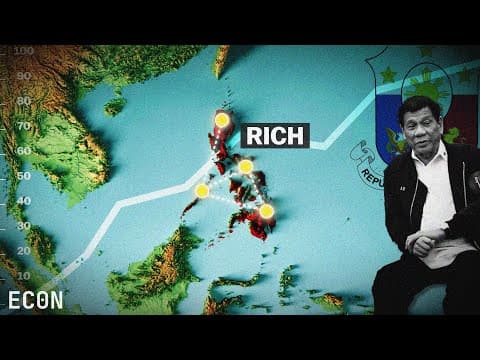
The Philippines has transformed from the 'sick man of Asia' to Southeast Asia's fastest-growing economy, yet income inequality persists, with the richest 1% controlling more wealth than the bottom 70%. This blog explores the factors behind the country's economic growth, the challenges it faces, and the implications for its future.
Imagine an archipelago of more than 7,000 islands, where crowded megacities meet lush rice terraces and white-sand beaches. This is the Philippines—a country whose economy, much like its landscape, is a tapestry of contrasts and surprises. Sitting in the heart of Southeast Asia, it remains one of the most interesting and overlooked nations in the world.
Just a decade ago, few believed the Philippines could catch up with its more prosperous neighbors. However, from 2010 to 2024, the economy grew at an average rate of 5.26% per year, outpacing Thailand, Malaysia, and even Indonesia in some years. By 2023, the Philippines became Southeast Asia’s fastest-growing economy, overtaking both Vietnam and Malaysia. As of 2025, the Philippines has a nominal GDP close to 500 billion dollars, ranking it 32nd in the world.
The country is home to 115 million people, most of them young, ambitious, and moving to cities. The skyline of Manila today is marked by cranes, glass towers, and nonstop construction—a clear sign of how far the country has come.
Despite this impressive growth, income inequality remains among the highest in the region. The richest 1% of Filipinos control more wealth than the bottom 70% combined. In Manila, luxury condos and high-end malls stand in stark contrast to markets where people struggle to get by on less than ten dollars a day. The average Filipino's output remains roughly a third of the global average, raising questions about the distribution of wealth in a country blessed with abundant natural resources.
The Philippines is essentially a scattered collection of 7,641 islands, with only about 2,000 inhabited. This fractured geography creates fascinating economic challenges. Transportation becomes incredibly complex and expensive, with the cost of moving goods within the Philippines among the highest in Southeast Asia. For instance, shipping a container from Manila to Davao can sometimes cost more than shipping it to Hong Kong or Singapore.
Manila, the capital region, is home to over 13 million people, making it one of the most densely populated urban areas in the world. Meanwhile, some islands remain sparsely populated, with limited infrastructure connecting them to the economic mainstream. However, the Philippines sits at a strategic crossroads of major shipping routes between the Pacific and Indian Oceans, which has led to a surge in foreign investment in recent years.
The Philippines now ranks 13th on the Foreign Direct Investment (FDI) Confidence Index for emerging economies, alongside Chile and Turkey. The relationship with the United States is particularly significant, as U.S. business investments have forged a strategic partnership with the Philippine government. This partnership has evolved to address changing regional security dynamics, especially in response to growing tensions in the South China Sea.
The U.S. military presence in the Philippines, established through the 1951 Mutual Defense Treaty, has contributed significantly to local business and commerce. However, not everyone views this presence positively. Some Filipinos, particularly activists, see it as a threat to national sovereignty, raising concerns about potential conflicts between the U.S. and China.
The Philippines was once among the richest and most advanced countries in Asia, second only to Japan in per capita income during the early 1950s. However, widespread corruption and mismanagement during the dictatorship of Ferdinand Marcos in the 1970s and 1980s led to economic stagnation. The turning point came with the People Power Revolution in 1986, which eventually set the stage for economic reforms and recovery.
From 2010 to 2024, the Philippines achieved impressive economic growth, averaging over 5.5% annually. GDP per capita more than doubled from $2,400 in 2010 to over $4,300 in 2025, and poverty rates declined from 23.5% in 2015 to under 17% today.
A significant factor in this growth has been the contribution of Overseas Filipino Workers (OFWs). Over 10 million Filipinos—nearly 10% of the population—work overseas, sending home a staggering $36.1 billion annually, equivalent to about 8.9% of the entire Philippine GDP. This remittance inflow surpasses earnings from the country's top export industries combined.
The Philippines has also become a global hub for digital exporting services, particularly in the Business Process Outsourcing (BPO) sector. This industry has evolved into a sophisticated $30 billion sector, employing 1.5 million Filipinos directly and supporting another 4.5 million jobs indirectly. The BPO industry has created a new middle class, with workers often earning two to three times the national average.
Despite these successes, the Philippines faces significant challenges. The outsourcing boom may be contributing to industrial stagnation, as fewer people are interested in manufacturing or developing local industries. The country's geography complicates industrial development, with limited infrastructure to connect the islands.
Additionally, the Philippines continues to experience brain drain, losing highly skilled professionals to better opportunities abroad. This talent gap poses a long-term risk to the country's economic potential.
The Philippines has developed a consumption-driven economic model, with nearly 75% of its GDP coming from domestic consumption. This model has proven resilient during global downturns, but it has also led to persistent trade deficits, with the country importing more than it exports.
As the Philippines continues to grow, strong institutions will be essential for sustainable development. Corruption remains a significant issue, ranking 114th out of 180 in Transparency International’s Corruption Perceptions Index. Addressing corruption and improving governance will be crucial for the Philippines to harness its natural resources and drive inclusive development.
The Philippines has already surprised the world by rising from the 'sick man of Asia' to one of Southeast Asia’s most dynamic economies. The next transformation—toward truly shared prosperity—could be even more powerful. The decision lies with the Filipino people and their leaders, as the world watches closely what happens in this archipelago of islands.