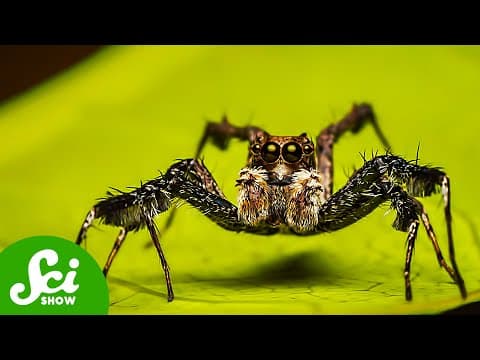
Portia spiders, a genus of jumping spiders, exhibit extraordinary cognitive abilities such as planning, learning through trial and error, deception, and object permanence, challenging traditional views that intelligence correlates with brain size. Their behaviors suggest cognition evolved in diverse ways across species, urging a shift from human-centered intelligence benchmarks to a broader, biocentric perspective.
Imagine a hunter stalking its prey with keen eyes, carefully analyzing its surroundings, and plotting the best course to capture its target. This hunter patiently executes every move with not just primal instinct but with wily calculation, honed through experience. At the perfect moment, it leaps to seize its meal. This scene might evoke images of a cat or a human hunter in the woods. However, this hunter is neither a mammal nor a bird, nor even a vertebrate. It is a spider — specifically, a genus of jumping spider known as Portia.
These spiders are so intelligent that they have revolutionized how scientists view cognition, especially in invertebrates. They challenge long-held assumptions about the relationship between brain size and cognitive ability, forcing us to rethink what it means to think.
Traditionally, scientists believed that an animal's cognitive abilities were roughly proportional to its brain size and morphological complexity. Creatures with tiny brains and exoskeletons, like spiders, were not expected to perform complex cognitive tasks. Yet, Portia spiders defy these expectations by demonstrating abilities such as:
The processing power required for such behaviors seems impossible to fit into their minuscule brains. Yet, these spiders think in ways that are strikingly sophisticated.
Cognition broadly encompasses all forms of thinking and knowing. It differs from mere instinct or reflex, which are automatic responses not involving conscious thought. Traditionally, primates rank highest in cognition, followed by other mammals and vertebrates. However, recent discoveries about the intelligence of certain birds, like crows and ravens, have complicated this hierarchy.
Invertebrates have generally been considered the least cognitively capable. However, this view is increasingly challenged by species like Portia spiders, octopuses, and bees. These animals demonstrate that intelligence can manifest in diverse forms, not necessarily mirroring human thought processes.
Portia spiders belong to the Salticidae family, which includes thousands of jumping spider species. Unlike many spiders that rely on webs to catch prey, Portia spiders prefer to hunt other spiders. This predatory lifestyle demands advanced cognitive skills.
Portia spiders have eight eyes, with two large, distinctive primary eyes on the front of their faces, giving them a cat-like appearance. The other six smaller eyes are arranged in pairs behind the primary set, each serving different functions. This eye arrangement provides them with an exceptionally detailed and wide field of vision.
However, their intelligence goes beyond visual perception. They exhibit planning based on mental representation — the ability to recall and consider abstract concepts or objects not immediately visible. For example, when a Portia spider spots prey from a distance, it doesn’t simply rush in. Instead, it contemplates the situation and plans a strategic attack.
A 1997 study on Portia fimbriata, an Australian species, revealed their remarkable problem-solving skills. Researchers placed spiders on a platform where prey was visible but unreachable by a direct path. The spiders paused to visually scan the environment, then chose and took complex detours around obstacles, even when they lost sight of the prey during the route. They could persist on these detours for over an hour, demonstrating a form of object permanence previously unexpected in invertebrates.
Portia spiders also assess risk intelligently. For instance, some Portia species prey on spitting spiders, which can immobilize them with sticky saliva. When encountering a spitting spider on its web, Portia approaches cautiously from behind to avoid being hit. However, if the spitting spider carries an egg sac and cannot spit, Portia attacks directly.
Moreover, Portia spiders use deception to catch prey. Web-building spiders detect prey or predators by sensing vibrations on their webs. Portia spiders mimic these vibrations through various abdominal and limb movements, experimenting with different patterns until they imitate signals that attract their prey, such as those of a potential mate or trapped insect. This trial-and-error approach to deception shows advanced cognitive processing.
The extraordinary abilities of Portia spiders challenge the traditional anthropocentric view that human intelligence is the pinnacle of cognition. This view assumes that complex abilities like language, planning, and abstract thinking evolved together uniquely in humans.
Instead, a biocentric perspective values all life forms equally and recognizes that cognitive abilities evolve in response to environmental demands. Portia spiders inhabit diverse habitats across Africa, Asia, and Australia, and their cognitive skills likely evolved to meet the specific challenges of their environments.
This suggests that cognitive abilities may have evolved in varied combinations across species, depending on their needs. For example, while humans rely heavily on language, other species may develop different but equally sophisticated cognitive strategies, such as Portia’s trial-and-error web vibrations.
Portia spiders are not just smart for spiders; they are genuinely intelligent creatures that defy our expectations about brain size and cognition. Their remarkable abilities in planning, learning, deception, and risk assessment provide valuable insights into the diversity of intelligence in the animal kingdom.
As scientists continue to study these eight-legged geniuses, we may need to broaden our understanding of intelligence beyond human-centric benchmarks and appreciate the unique cognitive worlds of other species.
The study of Portia spiders invites us to rethink what it means to think and challenges us to recognize intelligence in forms we never imagined possible.