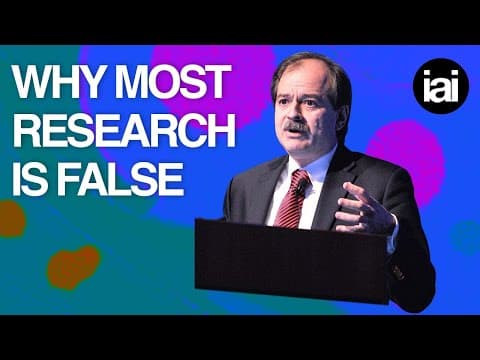
John Ioannidis discusses the ongoing reproducibility crisis in science, highlighting issues such as publication bias, the prevalence of sloppy research practices, and the rise of predatory journals and paper mills. He emphasizes the need for better research practices and the importance of recognizing biases in scientific literature.
In a thought-provoking talk, John Ioannidis revisits the critical issues surrounding the reproducibility crisis in science, a topic he first addressed in his seminal 2005 paper, "Why Most Published Research Findings Are False." He argues that despite some improvements, the fundamental problems in scientific research practices persist, if not worsen.
Ioannidis begins by acknowledging the sheer volume of scientific literature, with over 30 million people publishing peer-reviewed papers and around 200 million papers published to date. Each year, approximately 7 million new papers are added to this vast pool, many of which lack transparency and rigor. He notes that a significant portion of these publications resembles advertisements rather than genuine scientific contributions, often omitting essential data and methodologies.
Given the massive influx of scientific papers, assessing the credibility of individual studies becomes increasingly challenging. Ioannidis emphasizes that while many scientific disciplines employ the scientific method, they often have differing standards regarding validation and skepticism. This inconsistency contributes to the overall crisis in reproducibility.
Ioannidis draws an analogy between the universe of scientific research and the physical universe, suggesting that much of the data generated remains unpublished, akin to dark matter and dark energy. He posits that while some fields may improve over time, the overall landscape of scientific research may deteriorate if less rigorous fields expand more rapidly.
Ioannidis and his colleague David Cheras have mapped over 235 biases in biomedical literature alone. He points out that while biases like confounding and publication bias are frequently acknowledged, they are often dismissed as non-problems in individual studies. This tendency to downplay biases leads to a distorted understanding of scientific findings.
A significant concern raised by Ioannidis is the over-reliance on statistical significance in research. He notes that 96% of biomedical literature claims significant results, raising questions about the validity of these findings. He argues that many of these results should not be statistically significant, highlighting the pervasive influence of biases that convert non-significant results into significant ones.
Ioannidis presents a model illustrating the dynamics between diligent, sloppy, and fraudulent scientists. He suggests that while most scientists consider themselves diligent, they often perceive their peers as sloppy or fraudulent. This perception can lead to a system where those who cut corners or engage in unethical practices gain more recognition and funding, ultimately undermining the integrity of scientific research.
The landscape of scientific publishing has also changed dramatically, with the emergence of mega-journals and predatory journals that prioritize quantity over quality. Ioannidis warns that these journals often accept all submissions, making it difficult to discern trustworthy research from dubious studies. Additionally, the rise of paper mills—entities that produce fake research papers—poses a significant threat to the credibility of scientific literature.
Ioannidis concludes by stressing the urgent need for reforms in scientific research practices. He advocates for a system that rewards diligent scientists and penalizes those who engage in sloppy or fraudulent practices. As science becomes increasingly complex, addressing these issues is crucial to restoring trust in scientific findings and ensuring the integrity of research.
In summary, the reproducibility crisis in science is a multifaceted problem that requires collective action from the scientific community to improve research practices, enhance transparency, and combat biases that distort our understanding of scientific knowledge.