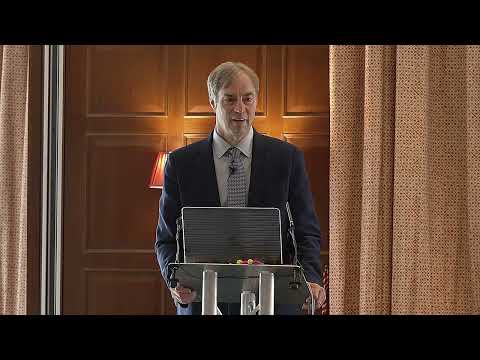
Stephen Meyer discusses his book 'Return of the God Hypothesis' at Cambridge, highlighting significant scientific discoveries that suggest a divine influence in the universe's origin and structure, while reflecting on his personal experiences in the academic environment.
Stephen Meyer recently presented his insights on the intersection of science and faith in his talk titled "The Return of the God Hypothesis" at Cambridge. This discussion not only highlighted the themes of his book but also reflected on the historical and contemporary scientific discoveries that bring the question of God back into the cultural conversation.
Meyer began by noting that many significant scientific discoveries that have reignited the God question have roots in Cambridge. He expressed gratitude for the opportunity to reflect on his journey and the divine providence that led him to explore this topic. The atmosphere at Cambridge, while intimidating, provided a rich backdrop for his academic pursuits.
Meyer shared personal anecdotes about his initial experiences at Cambridge, which included cultural and ideological challenges. He recounted a memorable high table dinner where he felt out of place among his peers, particularly when a fellow student announced his atheism. Despite feeling outnumbered, Meyer found encouragement in the historical acknowledgment of the Christian origins of modern science, which was evident in the works of early scientists.
Meyer emphasized that the early scientists, including figures like Johannes Kepler and Isaac Newton, were deeply influenced by their Christian beliefs. Kepler famously stated that he was "merely thinking God's thoughts after him," illustrating the connection between faith and scientific inquiry. Meyer pointed out that the natural theological tradition was not a deviation from science but rather its foundation, as scientists sought to understand God's creation.
Newton's work, particularly his laws of motion and gravity, was highlighted as a profound theological contribution to science. Meyer noted that Newton viewed the laws of nature as a mode of divine action, suggesting that the universe's order reflects a divine legislator. This perspective was crucial in shaping the scientific revolution and the understanding of the natural world.
Meyer discussed the shift in scientific thought during the 19th century, particularly with the rise of Darwinism. Darwin's theory of evolution by natural selection proposed a materialistic explanation for the diversity of life, which many interpreted as eliminating the need for a divine creator. This led to the emergence of scientific materialism, which posited that the universe operates without any guiding intelligence.
Despite the dominance of materialism, Meyer identified three major scientific discoveries that challenge this worldview:
The Expanding Universe: Edwin Hubble's observations of galaxies moving away from each other suggested a beginning to the universe, contradicting the idea of an eternal, static cosmos. This discovery aligns with the biblical notion of creation.
Fine-Tuning of the Universe: The precise conditions necessary for life indicate a universe that is finely tuned. Meyer referenced the work of physicists like Fred Hoyle, who shifted from atheism to a belief in intelligent design after recognizing the improbability of such fine-tuning occurring by chance.
The Discovery of DNA: The revelation that DNA contains complex information akin to a digital code suggests an intelligent source behind the origin of life. This challenges the materialistic explanations for the emergence of life and points towards a designer.
Meyer emphasized that many of these discoveries were made or elaborated upon in Cambridge, making the city a significant landmark in the discussion of science and faith. He encouraged attendees to explore the historical sites related to these scientific advancements, reinforcing the connection between the scientific community and the exploration of divine influence.
In conclusion, Stephen Meyer’s talk at Cambridge illuminated the ongoing dialogue between science and faith. By revisiting the historical context of scientific discovery and highlighting contemporary findings, he made a compelling case for the return of the God hypothesis in modern scientific discourse. The evidence presented suggests that the universe's complexity and order may indeed point to a divine creator, inviting further exploration and discussion in both scientific and theological realms.