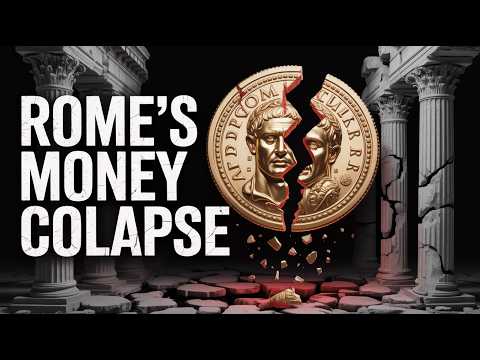
The fall of Rome was not solely due to external invasions but significantly influenced by the collapse of its currency, the denarius. This blog explores how monetary debasement led to inflation, economic chaos, and ultimately the empire's decline, drawing parallels to modern economies and the lessons we can learn from history.
When people think about the fall of Rome, they often envision barbarians storming the gates, legions collapsing, or emperors poisoned in marble palaces. However, empires do not crumble solely from external attacks; they often rot from within. One of the most corrosive forces in this decay is money. Rome's downfall was not just a result of invasions or corruption; it was significantly influenced by the collapse of its currency. The lessons from this collapse remain relevant to modern economies that believe they can manipulate money without consequences.
For centuries, the economic backbone of Rome was the silver denarius. First minted around 211 BC, it was nearly pure silver and trusted across the empire and beyond. Roman soldiers were paid in denarii, merchants demanded it, and ordinary citizens stored their wealth in it. The denarius represented not just money but confidence in metal form. The power of the empire and the value of the coin were intrinsically linked. As long as people believed in Rome, they believed in its currency.
Running an empire is expensive. By the second century AD, Rome was stretched thin, defending its borders against Germanic tribes, Parthians in the East, and dealing with internal unrest. Tax revenues could not keep pace with military costs, leading emperors to resort to an age-old trick: debasement. Instead of increasing taxes—an unpopular move—they reduced the silver content in the denarius.
The numbers tell a stark story. Under Emperor Augustus, the denarius contained about 95 percent silver. By the reign of Caracalla in the early third century, it had dropped to around 50 percent. By the time of Emperor Gallienus in the mid-third century, the denarius contained less than 5 percent silver. What was once a solid coin became a disc of bronze coated with a silver wash. The people could see and feel the difference, leading to rampant inflation.
As the value of money eroded, prices soared. A measure of wheat that once cost a single denarius might suddenly cost dozens. This was not just an abstract theory; it devastated the lives of ordinary Romans. Soldiers demanded higher pay to cover rising costs, and merchants stopped accepting debased coins, preferring barter or payments in gold. Local economies reverted to direct trade as trust in currency diminished. The cycle of debasement continued, with emperors striking cheaper coins in hopes that volume would replace value.
The crisis peaked during the so-called "Crisis of the Third Century." Between 235 and 284 AD, Rome experienced nearly fifty years of chaos: invasions, plagues, civil wars, and economic collapse. Emperors rose and fell at a dizzying pace, sometimes reigning only months before being assassinated. Behind this political drama lay a broken financial system. Taxes were demanded in coins worth less and less, leading farmers to abandon their lands rather than pay. Trade networks fractured, and desperate measures—such as price controls and forced labor obligations—failed to stabilize the economy.
One emperor, Diocletian, attempted to halt the economic decline. In 301 AD, he issued the Edict on Maximum Prices, which fixed the cost of over a thousand goods and services, from grain to labor wages. Violators faced severe penalties, including death. However, the edict was a disaster. Prices could not be controlled by decree when the currency itself was worthless. The black market exploded, and official trade collapsed. People quickly learned that laws could not restore value to a broken coin.
Eventually, Rome abandoned the denarius altogether. Constantine the Great introduced the solidus, a gold coin of consistent purity, around 312 AD. This new currency restored some stability and lasted for centuries in the Eastern Roman, or Byzantine, Empire. However, by then, the Western Empire was already fatally weakened. The debasement of the denarius had hollowed out Rome's economic core, making it impossible to sustain armies, maintain trade networks, and preserve trust.
What does this historical narrative mean for us today? It illustrates that the destruction of money often leads to the destruction of empires. Rome believed it could deceive its citizens by issuing coins that looked the same but contained less real value. Modern governments often engage in similar practices by printing paper money, manipulating interest rates, or inflating away debts. The outcome remains consistent: the people bear the burden, wealth is destroyed, and trust collapses.
The lessons from Rome's currency crisis are echoed in every major inflationary crisis since. After World War I, Germany faced crushing reparations under the Treaty of Versailles and resorted to printing marks to cover its obligations. By 1923, hyperinflation had taken hold, with a loaf of bread costing over 200 billion marks by the year's end. Similarly, Zimbabwe experienced hyperinflation in the early 2000s, with an annual rate of 89.7 sextillion percent by 2008, forcing citizens to abandon their currency entirely.
Even in modern developed economies, the Roman pattern persists. In 1971, President Richard Nixon took the dollar off the gold standard, severing the last link between currency and tangible value. This shift transformed the dollar into a fiat currency, backed not by gold but by trust in government. Since then, debt has ballooned, the money supply has expanded, and inflation has become a constant undercurrent.
What makes the current situation particularly dangerous is the global scale of financial fragility. Rome's collapse was an imperial crisis, Weimar's hyperinflation was national, and Zimbabwe's was local. Today, the entire world operates on fiat currencies, massive debts, and central banks willing to print trillions at the first sign of crisis. The next collapse is unlikely to be confined to a single empire or country; it will ripple across the globe, affecting millions who rely on salaries, pensions, and savings in increasingly fragile currencies.
As individuals, there are several critical lessons to draw from Rome's currency crisis:
The fall of Rome serves as a stark reminder that financial systems can collapse slowly, then suddenly, as trust evaporates. When money loses its value, society begins to unravel. Contracts fail, trade breaks down, armies dissolve, and governments lose legitimacy. While the barbarians at the gate may finish the job, the real threat often lies within the treasury.
History does not repeat itself, but if we fail to learn from it, we risk being crushed by its lessons. The Roman currency crisis was not merely about bad emperors or greedy elites; it was about the inherent fragility of money when abused by those in power. This fragility remains relevant today, and understanding it is crucial for navigating the complexities of modern economies.