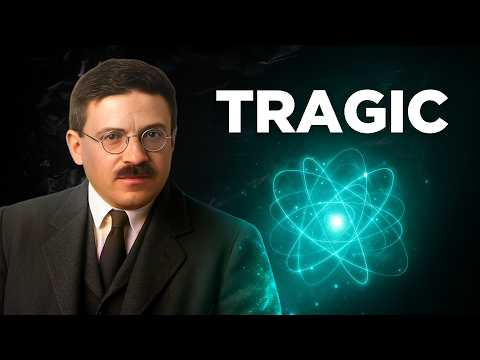
Paul Ehrenfest, a brilliant physicist and friend of Einstein, struggled with personal demons and societal challenges throughout his life. His tragic end came after years of depression and the burden of caring for his son with Down syndrome. Despite his significant contributions to physics, Ehrenfest remains largely overlooked today. This post explores his life, work, and the impact he had on modern physics, highlighting the importance of mental health and recognition in the scientific community.
On September 25, 1933, Paul Ehrenfest entered the waiting room of an institute in Amsterdam, where his son, Wassik, who had Down syndrome, was being cared for. In a moment of despair, he ended his son’s life and then took his own. This unfathomable act overshadowed a remarkable life filled with scientific brilliance and personal struggles. Ehrenfest was not only a gifted physicist but also a close friend of Albert Einstein, who regarded him as "the best teacher in our profession whom I have ever known." Yet, despite his talents, Ehrenfest battled self-doubt and depression throughout his life. This is the story of one of the most tragic scientists in history.
Paul Ehrenfest was born on January 18, 1880, in Vienna, Austria, to a poor Jewish family. His father, originally a weaver from Moravia, became a successful grocer in Vienna’s proletarian Favoriten district. Paul was the youngest of five boys and faced an unhappy childhood marked by loss; his mother died of breast cancer when he was just 10, and his father passed away when he was 16 due to stomach ulcers.
Despite these hardships, Ehrenfest found solace in mathematics and physics, particularly through attending lectures by Ludwig Boltzmann. He began his studies in chemistry at the Technical University of Vienna but soon moved to Göttingen, Germany, seeking a richer scientific environment. There, he immersed himself in mathematics and physics, and notably fought to allow women to attend mathematics club meetings, showcasing his early commitment to equality.
Ehrenfest met Tatyana Afanasyeva, a Russian math student, in Göttingen. Their love faced challenges due to their differing religious backgrounds; Paul was Jewish, and Tatyana was Russian Orthodox. To marry in 1904, they renounced their religions. Tragically, two years later, Boltzmann, who had been a mentor to Ehrenfest, took his own life, leaving Paul devastated. In his grief, he dedicated himself to simplifying Boltzmann’s complex ideas, leading to the development of the Ehrenfest model of diffusion.
This model illustrated how random motion drives systems toward equilibrium, a principle applicable in various scientific contexts. Ehrenfest's work continued to flourish, but he struggled to find stable employment due to his status as a foreigner and a Jew. His feelings of insecurity were compounded by the societal pressures of the time.
Ehrenfest's fortunes changed in 1912 when he embarked on a lecture tour across Europe, reconnecting with prominent physicists like Max Planck and Arnold Sommerfeld. His friendship with Einstein blossomed during this time, and Einstein proposed Ehrenfest as his successor in Prague, a position he declined due to his lack of formal religious affiliation.
In April 1912, Hendrik Lorentz sought a successor for his theoretical physics chair at Leiden University in the Netherlands, and Sommerfeld championed Ehrenfest for the role. By September, he received the news of his appointment, which filled him with gratitude and a renewed sense of purpose. The Ehrenfest family lived simply in Leiden, where their home became a hub for scientific minds, including frequent visits from Einstein.
Ehrenfest was not only celebrated as a teacher but also made significant contributions to physics. One of his notable ideas was published in 1914 regarding adiabatic invariants. He illustrated this concept using a pendulum, explaining how its frequency and energy adjust while maintaining a constant ratio as conditions evolve slowly. This insight became foundational in the old quantum theory.
During the war years, the Ehrenfest household was vibrant with ideas, and Paul and Tatyana chose to homeschool their children, believing that traditional schooling stifled curiosity. However, their family faced challenges when their youngest son, Wassik, was born with Down syndrome, which weighed heavily on Ehrenfest and would later lead to tragedy.
By the 1920s, Ehrenfest began to feel increasingly out of place in the rapidly evolving field of physics. The shift towards abstract concepts in quantum mechanics left him feeling inadequate, especially as younger physicists like Heisenberg and Schrödinger emerged with bold new ideas. Despite his feelings of inadequacy, he published his most significant work in 1927, connecting quantum mechanics to classical physics through Ehrenfest’s theorem, which demonstrated that the average motion of quantum particles still obeyed Newtonian laws.
However, the Great Depression exacerbated his insecurities, leading him to believe he would lose his position at Leiden. In a moment of despair, he began an affair with a young art critic named Nelly, which ultimately strained his marriage. When Tatyana discovered the affair, she requested a divorce, plunging Ehrenfest into deeper despair.
As the political climate in Europe darkened with the rise of the Nazis, Ehrenfest's mental health deteriorated. He was deeply affected by the antisemitism spreading across the continent, and the safety of his son Wassik became a pressing concern. After moving Wassik to an institution in Amsterdam, Ehrenfest contemplated his tragic final act for some time. In a letter to friends, he expressed his despair over his inability to keep up with developments in physics and his weariness of life. Although he never sent the letter, it was found among his belongings after his death.
On that fateful day in September 1933, Paul Ehrenfest took the lives of his son and himself, leaving behind a legacy that, while significant, has often been overlooked in the annals of physics.
Today, Paul Ehrenfest is largely forgotten, even among physicists. His biographer, Martin Klein, poignantly noted that no one was more engaged in the struggle to create the concepts of twentieth-century physics than Ehrenfest. He was committed to maintaining clarity amidst the flood of new developments, earning him the informal title of "the conscience of physics."
Ehrenfest's brilliance lay in his ability to make complex physics accessible, turning abstract ideas into tangible concepts. His life serves as a reminder of the importance of mental health and the need for recognition and support within the scientific community.
In conclusion, Paul Ehrenfest's story is one of profound tragedy intertwined with remarkable achievements. His contributions to physics continue to influence the field, and his legacy deserves to be remembered and celebrated.