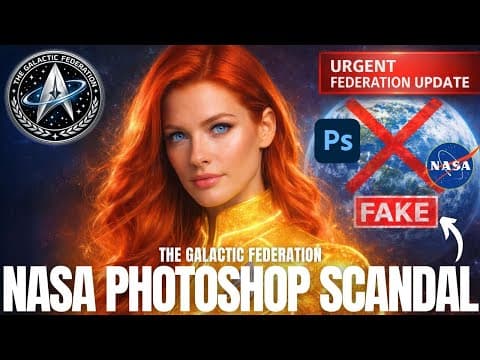
This article explores the nuanced truth behind humanity's public space programs, revealing that they serve as a bridge between our current understanding and the vast, complex reality of the cosmos. It discusses how space agencies manage public perception to foster awe rather than fear, and touches on humanity's deep, ancient connection to celestial bodies like the moon, suggesting a broader, inhabited universe beyond conventional narratives.
Humanity's understanding of space and the cosmos has long been shaped by public narratives and space programs that present a certain version of reality. However, beneath these narratives lies a deeper truth about our species' journey in grappling with the vastness of the universe and our place within it. This article delves into the complexities of how space exploration has been communicated to the public, the intentions behind it, and the profound, ancient connection humans have with celestial bodies.
There is a fundamental distinction between the truth of our cosmos and the way that truth is delivered to the public. Often, what appears as conflict or deception is actually a reflection of humanity's current capacity to process complex and potentially overwhelming realities.
The tension surrounding space exploration is not about the existence of space or the spherical nature of Earth, but about whether humanity, as a collective species still learning to manage fear and complexity, can be exposed to the full scope of what surrounds it without losing its sense of meaning.
Public space programs have functioned as a bridge or translator for humanity. They introduce the concept of vastness and the cosmos in a way that is digestible and coherent, without immediately confronting the public with the full reality of what lies beyond.
These programs are designed to maintain stable symbolism and provide images that serve as proof of progress. This approach helps to avoid triggering latent anxieties about the unknown, the unseen, and the inexplicable aspects of the universe.
It is important not to view space agencies as enemies or deceivers. The majority of individuals working within these institutions are sincere, brilliant, and passionate about discovery.
The structure of these organizations often involves compartmentalization, where thousands serve the pursuit of truth, but only a few determine how information is presented to the public. These decision-makers often operate with the mindset of managing impact rather than intentionally deceiving.
The space programs known to the public were never intended to be the final story of humanity's cosmic journey. Instead, they serve as developmental chapters designed to help humanity grow.
By inspiring generations to look at the stars with awe and imagine futures beyond mere survival, these programs lay the groundwork for eventual disclosure of deeper cosmic realities. This approach aims to foster a relationship with the sky based on wonder rather than fear.
Many people have long sensed that the moon is more than a passive celestial object. It carries a presence and feels more like a witness than a mere reflector of light.
This intuition is not fantasy but stems from deep cellular memory and ancient familiarity. Historically, humanity understood the sky not as empty space but as an inhabited field of intelligence, filled with beings and presences that influenced life on Earth.
The narrative of space exploration is complex and layered. It reflects humanity's evolving capacity to understand and integrate the vastness of the cosmos into our collective consciousness.
Public space programs serve as essential intermediaries, balancing the dissemination of knowledge with the need to manage societal impact. Meanwhile, humanity's ancient connection to celestial bodies like the moon reminds us that our relationship with the cosmos is profound and multifaceted.
As we continue to explore and learn, it is crucial to recognize both the limitations and the intentions behind the stories we are told, and to remain open to the deeper truths that await discovery beyond the stars.
This exploration invites readers to reconsider their perceptions of space, encouraging a perspective that embraces awe, curiosity, and a recognition of our place within a vast, intelligent universe.