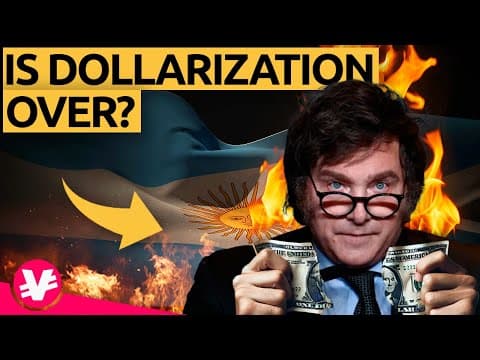
Javier Milei's presidency has seen significant economic reforms in Argentina, yet the anticipated dollarization remains unfulfilled. This article explores the complexities and challenges surrounding Milei's dollarization plan, the current economic landscape, and the potential future of Argentina's currency policy.
More than a year has passed since Argentina surprised the world with the election of Javier Milei as president. From his first speech, Milei made it clear that he intended to revolutionize the country. His approach to governance has been characterized by swift and drastic reforms, which many analysts initially doubted he could implement given his minority status in Congress and the Senate.
Milei's administration has undertaken one of the largest peacetime adjustments in history. Public budgets have shifted from a cumulative primary deficit of 1.5% to a surplus of 1.7%. However, the real challenge lies not in the budgets but in the balance sheet of the Central Bank, where the most significant reforms have been concentrated. The total adjustment has amounted to approximately 13 points of GDP.
Despite these achievements, the sustainability of these reforms remains in question. Historical precedents, such as Poland's brief surplus after transitioning from communism to capitalism, raise concerns about whether Milei can maintain these reforms over time.
One of the most significant promises of Milei's campaign was dollarization, which has become increasingly contentious. As inflation stabilizes without dollarization, questions arise about the necessity and feasibility of this policy. Has Milei abandoned the idea of dollarization? Currently, there is no indication that he has, but the approach to achieving it is evolving.
Dollarization remains a fundamental policy for Milei's government. The rationale is clear: if the Peronists return to power, they could potentially reactivate the Central Bank's money printing, leading to inflation. In a dollarized economy, such actions would be curtailed, as increasing public spending would require raising taxes instead.
A pertinent example is Ecuador, which, after dollarizing, avoided becoming a second Venezuela under Rafael Correa, a leader with similar populist tendencies. This illustrates the potential benefits of dollarization in preventing inflationary policies.
When discussing dollarization, the common understanding is that the government would take its dollar reserves, divide them by the total pesos in circulation, and establish a new exchange rate. However, this method poses risks, as seen in Ecuador, where dollarization led to an immediate inflation spike of 60%.
Milei is exploring a more gradual approach to dollarization, where pesos would naturally diminish in circulation. The Central Bank has frozen the monetary base, only issuing new pesos to offset rising prices. This strategy aims to create a scenario where pesos become increasingly scarce, facilitating a smoother transition to dollarization.
A significant hurdle in the dollarization process is the current exchange rate controls in Argentina. The government dictates the price of dollars, and these controls must be lifted to allow for a gradual replacement of pesos with dollars. Since Milei's administration began, the peso has been devalued by over 50%, and a programmed devaluation of 2% per month has been implemented.
The government is cautious about lifting exchange controls due to the potential for a carry trade bubble. This investment strategy allows individuals to profit from the appreciation of the peso, but it also risks a massive outflow of pesos if investors suddenly convert their holdings back to dollars. This could lead to a sharp depreciation of the peso.
For dollarization to be successful, confidence in the peso must be established. This involves improving the Central Bank's balance sheet, which has seen a reduction in public debt relative to assets. However, the peso's recent appreciation raises questions about its sustainability and whether it is a result of genuine economic improvement or speculative trading.
Milei's administration aims to stabilize the economy before eliminating exchange controls. The plan is to reduce the official rate of peso devaluation and maintain inflation below 2% for three consecutive months before considering lifting these controls. This timeline suggests that significant changes may not occur until the second quarter of 2025.
As Argentina navigates these complex economic waters, the future of dollarization remains uncertain. While progress is being made towards a more dollar-centric economy, significant challenges lie ahead. The government's cautious approach reflects a desire to ensure stability before making any drastic changes. The questions now are: Will the peso maintain its newfound strength? When will exchange controls be lifted? And what form will dollarization ultimately take under Javier Milei's leadership?