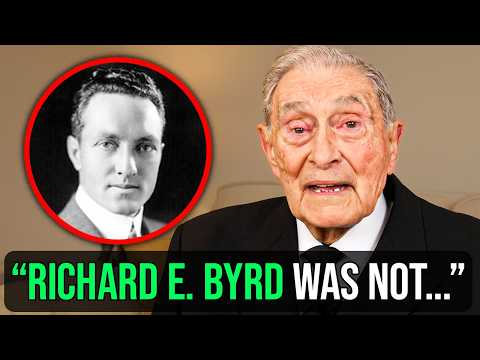
For 77 years, the truth about Admiral Byrd's Antarctic expeditions remained hidden. Robert Johnson, the last survivor, reveals shocking details about Operation Highjump, unexplained phenomena, and a mysterious three-hour gap in Byrd's flight records that could change our understanding of history and Antarctica's secrets.
For 77 years, the truth about Admiral Richard E. Byrd’s Antarctic expeditions lay frozen, locked away in military archives and in the mind of one man. Now, before his death, the last survivor has spoken. What he revealed is more than history—it’s a secret that could rewrite everything we know about Earth.
Admiral Richard Evelyn Byrd Jr. was not just another name in the annals of exploration—he was a man whose very life seemed pulled from the pages of an epic adventure novel. Born in 1888 into a prominent Virginia family, Byrd was destined for a life of distinction. From the moment he joined the U.S. Navy, his career was marked by daring feats and a relentless drive to be the first at everything. His peers respected him, his superiors trusted him, and the public adored him.
Byrd’s reputation was cemented early on with a series of bold aerial achievements. In 1926, he claimed to be the first person to fly over the North Pole—an accomplishment that made him a household name and earned him the Congressional Medal of Honor. He followed that with record-breaking flights across the Atlantic and to the South Pole, becoming the first to navigate the planet’s most inhospitable frontiers from the sky. New York City gave him not one, but three ticker-tape parades in his honor—an honor few could dream of, let alone achieve.
This craving for exploration was more than glory quests. Every one of those voyages would become, for Byrd, a challenge involving human limits and another opportunity to go where no man has gone before. While others regarded the frozen poles as deserted wastelands, Byrd viewed them as blank pages awaiting the ink and brush of history to fill them in. This desire to chart the uncharted would bring him back to Antarctica over and over again, to ever bolder and more secret missions.
Byrd's first expedition to Antarctica, in 1928, was one of stupendous success. The team set up a small American base along the Ross Ice Shelf, conducted extensive aerial mapping, and touched upon the huge, untouched potential of the continent. His next major expedition in 1933 was even bolder, as he decided to spend five months alone in a remote meteorological station, cut off from the harshest conditions on Earth, where he almost lost his life due to carbon monoxide poisoning. This brush with death sharpened his resolve.
However, whispers began to circulate in naval circles that Byrd's Antarctic trips were not merely for mapping ice and studying weather. Strange formations and geological wonders were reported that defied explanation. It was in 1939, just before another Antarctic undertaking, that Lieutenant Byrd met nineteen-year-old Robert Johnson, a sea scout from San Diego. Johnson thought he was offering his services for a simple scientific expedition, but Byrd's strange questions hinted at something more.
To most people in the 1940s, Antarctica was little more than a blank spot at the bottom of the map—an endless sheet of white, home only to penguins, seals, and howling winds. But to world powers teetering on the edge of the Cold War, it was a colossal chessboard where the stakes weren’t just land, but global dominance. Beneath that ice, scientists suspected, were vast mineral deposits—coal, oil, even uranium—that could power nations for centuries.
By the time Robert Johnson set foot there with Admiral Byrd, Antarctica had become a silent prize in an undeclared race. It was larger than the United States and Mexico combined, with no government, no borders, and no legal claims recognized by the world. The great powers knew this could change overnight. All it would take was a permanent base, a flag in the snow, and a few months of occupation to tilt the balance of power.
The public image of Antarctic exploration was clean, almost romantic: brave men braving the cold for the sake of science. However, behind that propaganda was a very different reality. Nations weren’t just measuring wind speeds—they were mapping potential runways, scouting supply routes, and quietly marking areas rich in resources. Johnson later recalled how compasses spun in lazy circles, failing to point north, and radio signals sometimes vanished into static.
The ice itself was eerie; in some places, it shimmered like a pearl catching light, and in others, it glowed from within. Such phenomena were susceptible to scientific explanation, but others defied it. One flight was characterized by the Aurora Australis, the Southern Lights, spiriting its patterns almost as if deliberately contorting into shapes that lasted longer than natural bounds. Old veterans muttered that the lights were "watching" them, a notion officers discouraged but never quite managed to stamp out.
Byrd himself rarely commented on such peculiarities, but Johnson noted how sharply the admiral paid attention whenever oddities were reported. More than once, Byrd discreetly altered a flight plan or directed a ground crew to survey areas for unusual readings. The terrain added to their discomfort, with Antarctica's jagged mountains rising from the flat ice, revealing dark stone even at temperatures well below freezing. There were murmurs that these exposed areas were not entirely natural, formed by something from beneath the ice pushing upward.
In the winter of 1946, the United States launched what would become the largest Antarctic expedition in history, officially called Operation Highjump. It was described as a “training exercise” designed to test men and machines in extreme cold, map uncharted coastline, and practice resupply operations in hostile environments. However, the scale alone suggested something far beyond scientific research.
Highjump’s numbers were staggering: 14 ships, including an aircraft carrier and destroyers; 33 aircraft; more than 4,700 personnel; tanks, tracked vehicles, and enough weapons to outfit a small invasion force. You don’t send that kind of firepower just to count penguins. To the men aboard, it felt less like a research trip and more like the opening move in a military campaign.
Once again, Robert Johnson, now in his twenties, was called to serve under Admiral Byrd. From the moment he set foot on board, he sensed a different atmosphere. The orders were adamant, the movements tracked, and the crew seemed to breathe with a quiet readiness, as if they awaited contact with something or someone.
Rumors about Nazi activity in Antarctica had swirled since the end of the war. Allegations suggested German vessels had slipped south in late 1945 to a hidden base in the polar wilderness. Johnson did not know what to believe, but he knew the Navy was not taking chances. Once the fleet was established in Antarctic waters, the mission activity had two layers: public activities like mapping runs and weather studies, and quieter operations bypassing normal communication channels.
By mid-expedition, Johnson's unit received orders to support a ground team heading toward a mountainous region marked "unstable" in earlier surveys. The snow melted in distinctly patterned shapes, almost as if something beneath the surface was radiating heat. The team never returned, officially lost due to a crevasse collapse during deteriorating weather, but Johnson knew the weather had been clear that day.
There’s a strange gap in the record of Operation Highjump—a gap that has haunted historians, conspiracy theorists, and surviving veterans for decades. It wasn’t a missing day, or even half a day. It was exactly three hours—three hours in which Admiral Byrd vanished from radio contact during a routine flight. The official explanation was vague, with logs listing his takeoff and return but nothing in between.
For years, that blank space was just a curiosity until a document began circulating—what some claim was Byrd’s own private diary. In it, the admiral describes flying over a lush green valley, its slopes covered in forest, with rivers winding through the land. In Antarctica. During summer, yes—but still a place where no trees should exist.
Byrd's diary entry detailed how all his instruments screeched—compass needles twirled, gyroscopes failed, and the sun was no longer visible. He then observed enormous creatures of shaggy fur and deeply curving tusks, resembling mammoths. Lowering his altitude to see better, he encountered a city—an impossible city glowing with crystalline structures and rainbow light. Aerial vehicles, sleek and disc-shaped, glided alongside him, maneuvering with a precision unmatched by any plane of his time.
According to the diary, a voice spoke over the radio, commanding him to follow and prepare to land. He fought against it, but his plane descended on its own towards the shimmering city. The next part of the diary blurs the line between historical record and legend. Byrd claimed he was met by tall, blond, pale men who warned him about humanity's destructive path after the bombings of Hiroshima and Nagasaki.
Not long after Byrd’s unexplained three-hour flight, Robert Johnson received unusual orders. They didn’t come through the normal chain of command, and there was no written record. Johnson and a small group were to gear up for a rapid deployment by air to a location not on any map. As they approached the drop point, Johnson noticed a massive ridge of ice that didn’t glisten under the sun like normal snow; its surface looked dull, almost metallic.
Upon landing, they felt a noticeable warmth and a low vibration in the air, similar to a far-off machinery hum. At the bottom of the ridge, they found a long, narrow fissure in the ice, perfectly clean as if cut by a huge blade. Inside, the fissure opened into a tunnel made of a smooth, curved material that seemed engineered. Simple orders were given: investigate but do not enter. However, curiosity got the better of one officer, who slipped into the opening and vanished.
Another officer volunteered to go in after him, but when he was pulled back up, he was conscious yet utterly unresponsive. The immediate withdrawal of the team followed, with no samples collected or measures taken. Johnson's questions were met with silence, indicating he should not ask again. What he guarded next was even more unsettling—proof that someone had been there long before them.
When Operation Highjump ended abruptly in February 1947—months ahead of schedule—it wasn’t just the ships and planes that left Antarctica. Something else disappeared: the paper trail. Reports that should have been archived simply never arrived at their destinations. Flight logs were incomplete or missing, reconnaissance photographs vanished, and personnel rosters for certain assignments came back altered.
Johnson sensed a deliberate effort to close the curtain. Conversations aboard the ships became shorter, eyes more guarded, and the normal banter was replaced with silence. The explanation given back in port was dry and unconvincing: severe weather, logistical strain, mission complete. Admiral Byrd would hold one last press conference in South America, where he issued an unusual warning about a new enemy that could fly from pole to pole at incredible speeds. This remark was buried in headlines and never mentioned again.
Johnson noted that it was the last time Byrd made any provocative statements in public. The cleanup operations turned out to be disappointing. Johnson remembered seeing photographs taken during clear aerial runs—images of massive geometric shapes etched into the ice, some showing doors set into sheer ice walls. Those photos were labeled "classified" and locked away, only to disappear within months.
In 1959, the Antarctic Treaty was signed, turning the continent into a peaceful university for scientific research while forbidding military advancement and resource exploitation. Johnson viewed it as a lock on the last door to the truth, stating, "They didn't sign that to protect the penguins; they signed it to make sure nobody else went looking where we'd been."
By the time Robert Johnson reached his ninety-ninth birthday, he was the last surviving link to Admiral Byrd’s most controversial expedition. Everyone else who had been there was gone. For decades, he obeyed the unwritten rule: don’t talk. But now, with no one left to silence and no career left to protect, he decided it was time.
In a single recorded interview conducted quietly in his Virginia home, Johnson shared his testimony. He spoke about the mission-within-a-mission, the humming ridge, the fissure leading into engineered tunnels, and the two men lost—one forever, the other into a living silence. He described how, days later, the site was wiped off the surface, bombed out, really.
Johnson also recounted a troubling mission where he was ordered to guard what was described as a "former weather station" embedded in the ice. Instead of crushed metal shacks, he found a perfectly carved stairway descending into the glacier. An officer who attempted to descend was never heard from again. Johnson's final warning was clear: what we don’t know about Antarctica is far greater than what we do.
Do you think the truth has finally been told, or is there more buried beneath the ice?