Dr. Sidharth Ramesh shares his journey from medical school to founding Medblocks, focusing on the challenges of converting unstructured healthcare data into FHIR formats using generative AI and openEHR standards. He discusses the limitations of current EHR systems, the importance of standard APIs, and the advantages of openEHR in modeling clinical data effectively.
In a recent talk at HL7 FHIR DevDays 2024, Dr. Sidharth Ramesh, a doctor and founder of Medblocks, shared his personal journey and the challenges faced in converting unstructured healthcare data into FHIR formats. This blog post summarizes his insights on the limitations of existing EHR systems, the role of generative AI, and the advantages of using openEHR standards.
Dr. Ramesh began his career in medicine in India, where he experienced firsthand the inefficiencies of healthcare data management. After completing medical school, he found himself spending hours transferring patient data between applications, which led him to develop a script to automate the process. However, this solution was limited to a single computer, highlighting the need for a more scalable approach to healthcare IT infrastructure.
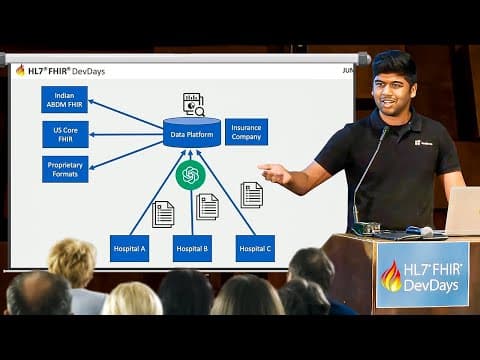
As Dr. Ramesh's journey progressed, he encountered a significant challenge while working with an insurance company that received various unstructured documents from multiple hospitals. These documents included PDFs, handwritten prescriptions, and even images unrelated to healthcare. The insurance company needed to analyze this data for adjudication decisions and export it into standardized formats like the Indian ABDM FHIR profiles and the US Core FHIR profiles.
Initially, the solution involved a team of medical coders manually inputting data from these documents into a program. This process was labor-intensive and costly, prompting the need for a more efficient method of capturing data from unstructured documents.
Dr. Ramesh outlined several key goals for improving data capture:
Dr. Ramesh considered several options for addressing these challenges:
Ultimately, Dr. Ramesh and his team opted for openEHR as a solution.
Dr. Ramesh clarified common misconceptions about openEHR:
Dr. Ramesh explained how openEHR works:
With the rise of generative AI, particularly large language models (LLMs), Dr. Ramesh discussed the potential for automating the extraction of structured data from unstructured documents. By generating JSON schemas based on openEHR templates, the team could streamline the data entry process and reduce costs significantly.
Dr. Ramesh's insights highlight the importance of rethinking healthcare data management. By leveraging openEHR standards and generative AI, healthcare organizations can improve the efficiency of data capture and enhance interoperability across systems. As the healthcare landscape continues to evolve, embracing these technologies will be crucial for building a more effective and standardized IT infrastructure.
For those interested in exploring the intersection of openEHR and FHIR further, Dr. Ramesh invites discussions and collaborations within the healthcare community. The ongoing dialogue between these two standards is essential for advancing healthcare data management and improving patient outcomes.