This blog post explores the key ideas of Adam Smith, particularly from his seminal work 'The Wealth of Nations', focusing on the division of labor, its impact on productivity, and the implications for wealth distribution and societal structure.
Adam Smith is often referred to as the father of modern economics, a title he has earned due to his profound insights into the workings of economies and societies. His seminal work, The Wealth of Nations, published in 1776, laid the groundwork for classical economics and introduced concepts that remain relevant today. This blog post delves into Smith's key ideas, particularly the division of labor, and contrasts his views with those of his contemporaries.
Adam Smith was a Scottish economist writing during a transformative period in history. His observations came at a time when the world was shifting towards new economic structures, particularly capitalism. Unlike Thomas Malthus, who had a more pessimistic view of economic progress, Smith offered a more optimistic perspective, predicting that the changes he observed would lead to greater wealth and productivity.
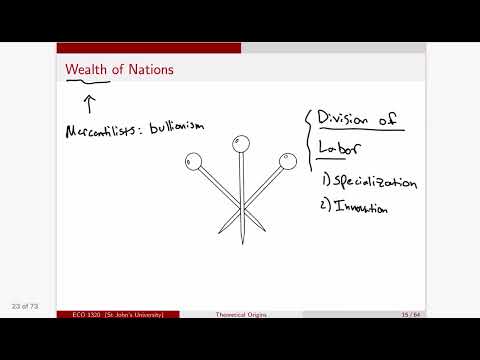
One of the most famous illustrations of Smith's ideas is his thought experiment involving a pin factory. In this scenario, Smith describes how five workers, each producing pins independently, could collectively produce only a few pins a day. However, when these workers are organized into a factory setting, each specializing in a specific task—drawing wire, cutting it, sharpening it, and so on—they can produce up to 10,000 pins a day.
Smith's concept of the division of labor is central to his argument. He posits that this division allows workers to specialize in specific tasks, leading to two significant outcomes:
These factors contribute to a dramatic increase in output, which Smith argues is the true measure of a nation's wealth.
In The Wealth of Nations, Smith challenges the mercantilist view that a nation's wealth is determined by its stock of gold and silver. Instead, he argues that the wealth of a nation is determined by its ability to produce goods and services efficiently. This perspective shifts the focus from mere accumulation of precious metals to the productivity of the economy.
Smith emphasizes that the division of labor emerges from the pursuit of profit. In a market economy, individuals are incentivized to produce goods not just for personal consumption but for sale. This profit motive drives innovation and efficiency, leading to greater overall wealth. Smith famously states that it is not the benevolence of producers that drives the economy, but their self-interest. This self-interest, he argues, ultimately benefits society as a whole.
A key concept introduced by Smith is the idea of the "invisible hand," which suggests that individuals pursuing their own interests inadvertently contribute to the economic well-being of society. This metaphor illustrates how competition and self-interest can lead to positive outcomes, such as increased production and innovation.
While Smith highlights the benefits of the division of labor, he also acknowledges its potential downsides. He warns that as workers become more specialized, they may lose their sense of identity and pride in their work. This dehumanization can lead to a workforce that is less engaged and less innovative, as workers become mere cogs in a machine.
Smith also recognizes that the benefits of increased productivity are not evenly distributed. While the division of labor enriches business owners and capitalists, workers may not see proportional gains. He argues that it is reasonable for the wealthy to contribute more to public expenses, suggesting a form of progressive taxation to address these inequalities.
Adam Smith's insights into the division of labor and its impact on productivity have had a lasting influence on economic thought. His optimistic view of capitalism and the mechanisms of the market has shaped modern economics. While he is celebrated for his advocacy of free markets and limited government intervention, it is essential to recognize the complexities of his arguments, including the potential downsides of specialization and the need for social responsibility. Smith's work continues to resonate today, reminding us of the intricate balance between individual ambition and collective well-being.