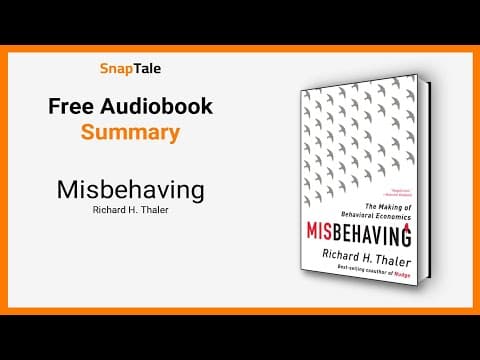
Richard H. Thaler's book 'Misbehaving' explores the flaws in traditional economic theories and introduces behavioral economics, emphasizing human irrationality, decision-making biases, and the importance of understanding psychological factors in economic behavior.
Dive into the realm of behavioral economics as we explore Richard H. Thaler's book 'Misbehaving: The Making of Behavioral Economics'. This work uncovers the shortcomings of traditional economic theories and their unrealistic assumptions that individuals always make optimal decisions. Behavioral economics introduces the study of psychology and the predictably irrational ways in which real people behave. This summary will discuss key concepts such as the endowment effect, hindsight bias, heuristics, prospect theory, loss aversion, the invisible hand, and the power of nudging people towards better decision-making.
Economics is influential due to its foundational theories, which assume that individuals make optimal decisions and that free markets tend towards equilibrium. However, these assumptions are flawed. Human decision-making is often biased and imperfect, leading to inaccurate economic forecasts. Behavioral economics, which integrates psychology and other social sciences, provides better explanations for economic behavior. While traditional economic models that assume rational decision-making have value, they do not reflect reality. Everyday decision-making, such as shopping or choosing a spouse, is far from optimal. The financial crisis of 2008 further revealed the shortcomings of economic models based on the rational behavior of "Econs." Thus, behavioral economics offers a more interesting and accurate alternative to traditional economic theory.
Humans exhibit a predictable misbehavior known as the endowment effect, which causes them to value what they already own more than what they can acquire. This phenomenon limits analysts' reliance on the theoretical behavior of Econs. People often underestimate their self-control problems while overestimating their sophistication. For instance, credit card companies have offered discounts to those who pay with cash, as people dislike surcharges more than they appreciate discounts. Understanding the endowment effect can help companies better market their products and services.
Psychologist Baruch Fischhoff suggests that humans tend to exhibit hindsight bias, believing they knew the outcome of an event all along after it has occurred. This bias can be detrimental to businesses, as decision-makers may penalize individuals associated with failed projects. Fischhoff's colleagues, Daniel Kahneman and Amos Tversky, argued that the use of shortcuts or heuristics can lead to predictable biases and errors in decision-making. Herbert Simon's concept of bounded rationality suggests that individuals lack the mental capacity to handle complex issues. While traditional economic models include an "error term" that assumes errors are random, Kahneman and Tversky's work implies that rational decision-making models could produce non-random errors.
In 1944, economists John von Neumann and Oskar Morgenstern introduced the popular expected utility theory, which posits that the marginal utility of wealth decreases as individuals accumulate more wealth. However, psychologists Kahneman and Tversky proposed an alternative known as prospect theory, which emphasizes human irrationality in decision-making. According to prospect theory, changes in wealth impact people more than their absolute levels of wealth, and individuals display a stronger aversion to losses than their fondness for gains. This theory highlights how emotional biases and reactions can contradict rational economic principles. For example, loss aversion can lead people to take excessive risks to recover from losses. Despite economists' preference for mathematical models, prospect theory illustrates how human emotions and behaviors can significantly affect economic performance.
The concepts of the invisible hand and the sunk cost fallacy expose the limits of rational behavior in markets and economics. The invisible hand, a metaphor coined by Adam Smith, suggests that the independent actions of buyers and sellers benefit society through disciplined market behavior. However, the power of the invisible hand is often overstated, as markets do not necessarily turn individuals into perfectly rational agents. Even when prices are known to be incorrect, markets may not correct them. Similarly, the sunk cost fallacy, where individuals continue to invest in something despite its negative consequences, questions the rationality of economic behavior. Economists advocate for ignoring sunk costs, yet large-scale errors, such as the prolonged Vietnam War, may occur due to a commitment to perceived losses. Recognizing these concepts helps us understand the limitations of rational behavior in markets and economics, allowing us to avoid costly errors.
Perceptions of fairness are complex, and companies can benefit from understanding them. People generally view price increases to cover costs as appropriate but see increases aimed at boosting profits as unfair. This perception stems from the endowment effect, where individuals feel entitled to the terms of their transactions. Research indicates that human behavior is not solely driven by rational economic explanations; many individuals act cooperatively even when it is not in their financial interest. This is evident in the public goods game, where players contribute about half their stakes on average to the public good. Companies that prioritize fairness in their dealings with customers can foster long-term relationships and benefit their business.
Investors who focus on individual events rather than broader experiences may fall victim to myopic loss aversion, leading them to invest with excessive caution during frequent losses and take greater risks when losses are rare. This phenomenon, known as narrow framing, can significantly impact investment decisions. For instance, an experiment showed that investors who checked their portfolios more frequently were more cautious than those who checked them annually. Therefore, it is crucial to consider the bigger picture and avoid viewing events in isolation.
The efficient market hypothesis posits that stock prices reflect true value based on future dividend payments. However, in 1981, Robert Shiller discovered that prices of dividend-paying stocks vary widely, challenging this hypothesis. Additionally, closed-end funds often sell at discounts to net asset value, further questioning the theory. While the efficient market hypothesis serves as a normative guide to market behavior, it is less reliable in predicting actual market behavior. Shiller's research sparked debate about stock market efficiency, disrupting traditional beliefs and calling for new perspectives.
The application of behavioral science has gained traction in public policies worldwide, addressing human mistakes rationally. Various nudging strategies, such as automatic enrollment in retirement plans and the placement of housefly images in airport urinals, have proven effective. Countries like the US and the UK have experimented with these approaches, demonstrating the success of behavioral science in improving societal outcomes.
Behavioral economics has transformed the finance industry by testing fundamental theories with available data, yet its influence remains limited in macroeconomics. The field of macroeconomics still adheres to rational theories, making it challenging to find realistic behavior-based thinking. Incorporating behavioral insights into tax cuts could enhance economic growth, while reducing the costs associated with business failure could encourage entrepreneurship, as individuals tend to fear losses more than they appreciate gains. Greater integration of behavioral economics into the broader economic discourse could lead to improvements across the industry.
In conclusion, 'Misbehaving: The Making of Behavioral Economics' challenges the core assumptions of traditional economic theories and presents a more accurate representation of human decision-making. By exploring concepts such as bounded rationality, prospect theory, fairness, and narrow framing, Thaler emphasizes the importance of understanding human nature in economics. The power of nudging and the application of behavioral insights in public policies highlight the practical implications of this groundbreaking perspective. Embracing the teachings of behavioral economics may pave the way for a more accurate, relatable, and effective understanding of economic behaviors.