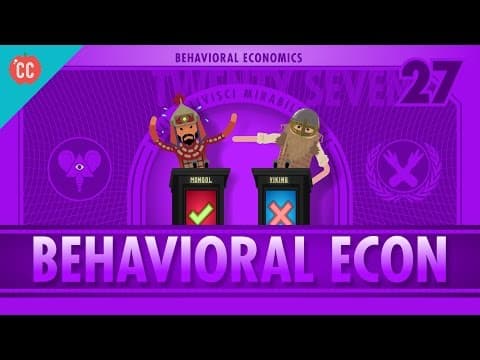
Behavioral economics explores the psychological, social, and emotional factors that influence human decision-making, challenging traditional economic theories that assume rational behavior. It highlights concepts like bounded rationality, the framing effect, and loss aversion, demonstrating how these factors shape our choices in various contexts, from consumer behavior to public policy.
In the realm of economics, traditional models often assume that individuals are rational and predictable in their decision-making. However, real human behavior frequently deviates from these assumptions, revealing a more complex landscape of impulsivity, shortsightedness, and irrationality. This blog post delves into the field of behavioral economics, which examines the psychological, social, and emotional factors that influence how people make decisions.
Behavioral economics is not a new concept; it has roots dating back to Adam Smith's discussions in The Theory of Moral Sentiments in 1759. Despite this, many economists historically overlooked the irrational elements of decision-making, as they complicate predictions about human behavior. In recent decades, however, behavioral economics has gained traction, earning several Nobel Prizes for researchers who integrate economics with psychology. This interdisciplinary approach is now being applied across various fields, including marketing, finance, political science, and public policy.
While many decisions are indeed rational—such as the tendency to buy more of a product when its price decreases—behavioral economics acknowledges the concept of bounded rationality. This term refers to the limitations on information, time, and cognitive abilities that prevent individuals from making the best possible choices. For instance, if ice cream prices drop significantly, consumers might buy less if they suspect that the low price indicates poor quality. This scenario challenges the classical law of demand, which states that lower prices should lead to higher demand.
Classical economics assumes that consumers have perfect information when making choices. In reality, however, individuals often lack access to complete information. For example, a consumer might hesitate to buy a low-priced ice cream due to uncertainty about its quality. Research has shown that price can significantly influence perceptions. A study involving wine tasting revealed that participants enjoyed wines more when they believed they were more expensive, even when the wines were identical. This finding illustrates how marketing can manipulate perceptions and, consequently, demand.
Behavioral economics also sheds light on the behavior of investors. Traditional economic theories suggest that investors will act rationally, buying undervalued assets and selling overvalued ones. However, real-world phenomena like market bubbles—such as the Dutch Tulip Mania and the 2008 financial crisis—demonstrate that investors can become irrationally exuberant, driven by emotions rather than logic. This behavior aligns with economist John Maynard Keynes's concept of "Animal Spirits," which refers to the instincts and emotions that drive human behavior in economic contexts.
One of the most illustrative experiments in behavioral economics is the ultimatum game. In this scenario, one player proposes a way to split a sum of money with another player. If the second player accepts the offer, both players receive the money; if they reject it, neither player gets anything. Surprisingly, offers that are perceived as unfair (e.g., 80/20 splits) are often rejected, even though accepting any offer would yield a better outcome than receiving nothing. This behavior contradicts classical economic theory, which assumes that individuals will always act in their best financial interest. Instead, human decisions are influenced by complex notions of fairness and justice.
The framing effect is another cognitive bias that impacts decision-making. The way options are presented can significantly influence choices. For example, people may prefer beef labeled as "75% fat-free" over one labeled as "25% fat," even though both descriptions convey the same information. Similarly, individuals may react differently to a raffle described as having "1 out of 1000 winners" versus one that highlights "999 losers." This demonstrates that framing can sway decisions, challenging the notion that people are entirely rational.
Businesses have long understood the psychology behind decision-making. For instance, gyms often advertise membership fees as costing only a dollar a day, making it seem more affordable than a lump sum of $365. This strategy, known as psychological pricing, plays on consumer perceptions. High-end retailers may set prices at whole dollars to signal higher quality.
Nudge theory is another concept in behavioral economics that encourages specific behaviors without restricting choices. For example, to combat childhood obesity, researchers rearranged school cafeterias to place healthier food at eye level, leading to increased consumption of fruits and vegetables. This approach demonstrates that subtle changes in the environment can significantly influence decision-making.
Behavioral economists also study how individuals perceive risk. For instance, if offered two sealed envelopes—one containing $100 and the other containing nothing—people may choose a guaranteed $50 instead of risking a 50/50 chance. This behavior reflects risk aversion, where individuals prefer to avoid losses rather than pursue potential gains. Studies show that losses tend to be more painful than equivalent gains are pleasurable, leading to conservative decision-making.
Understanding loss aversion can help businesses and policymakers shape decisions. For example, grocery stores in Washington, D.C., initially offered a five-cent bonus for using reusable bags, which had minimal impact. However, when they implemented a five-cent tax on plastic bags, usage decreased significantly. This shift illustrates that the pain of losing money can be a more powerful motivator than the pleasure of gaining it.
Additionally, research on loss aversion has shown that employees perform better when they are given bonuses upfront with the condition that they must pay them back if they do not meet specific goals. This strategy leverages the aversion to loss to enhance productivity.
Behavioral economics provides valuable insights into the complexities of human decision-making. By accounting for emotional and psychological factors, it offers a more realistic understanding of how people behave in economic contexts. While traditional economic theories have their merits, they often overlook the nuances of human behavior. Behavioral economics helps bridge this gap, revealing the intricacies of our choices and the factors that drive them.