This blog post explores the mechanisms of cell motility through actin polymerization, detailing the dendritic nucleation hypothesis, experimental findings from yeast cells, and the role of proteins in endocytosis and movement, while emphasizing the importance of quantitative measurements and mathematical modeling in biological research.
In this blog post, we delve into the fascinating world of cell motility, focusing on how actin polymerization generates the forces necessary for cellular movement and other processes such as clathrin-mediated endocytosis. This discussion is based on a two-part talk by Tom Pollard, a professor at Yale University, who has significantly contributed to our understanding of these mechanisms.
The dendritic nucleation hypothesis, proposed in the late 1990s, provides a framework for understanding how actin filaments contribute to cell movement. This hypothesis was visually summarized in a diagram by Dyche Mullins in 1998. While the biochemistry behind this hypothesis was well understood, the challenge remained to determine whether these biochemical processes occur as described in live cells.
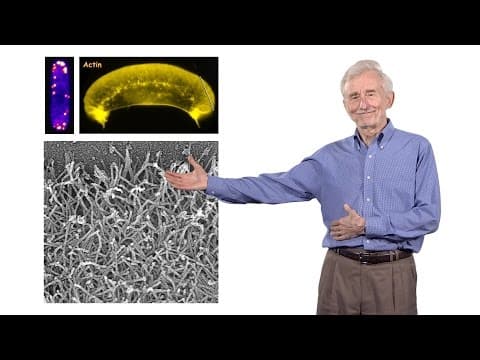
At the leading edge of motile cells, such as keratocytes, actin filaments are densely packed, making it difficult to observe individual events due to the rapidity of reactions. However, researchers found that studying fission yeast cells, which exhibit clearer temporal and spatial resolution, could provide insights into these processes. In yeast cells, bright spots in fluorescence micrographs indicate sites of clathrin-mediated endocytosis, where the same proteins involved in cell motility are utilized.
The experiments conducted on fission yeast cells allowed researchers to observe the dynamics of actin assembly and disassembly in a controlled environment. Time-lapse movies revealed that actin patches at endocytosis sites change color as different proteins are recruited and dissociated over time. The red signal indicates the presence of the nucleation promoting factor WASp, while the green signal represents the Arp2/3 complex. The transition from red to yellow to green illustrates the sequential recruitment and eventual dissociation of these proteins, consistent with the dendritic nucleation hypothesis.
Building on the observations, Jian-Qiu Wu developed a method to quantify fluorescence in yeast cells, allowing for a more precise understanding of protein dynamics. By measuring the total fluorescence from cells expressing tagged proteins, researchers could correlate fluorescence intensity with protein concentration. This quantitative approach enabled the tracking of protein accumulation and disappearance at endocytosis sites, revealing a predictable time course for the events involved.
To further explore the mechanisms of actin dynamics, Julien Berro created a mathematical model using ordinary differential equations to describe the biochemical reactions involved in actin assembly. The model assumed that the accumulation of WASp drives the entire process, and simulations were run to predict the number of molecules present over time.
The simulations revealed discrepancies between predicted and experimental data, prompting adjustments to the model parameters. Key findings included:
These adjustments highlighted the importance of the cellular context in biochemical reactions, emphasizing that cellular conditions can drastically alter reaction rates.
A critical discovery was the role of cofilin in severing actin filaments at endocytosis sites. Experiments showed that mutations in cofilin that slowed its severing activity resulted in brighter and more sluggish actin patches, confirming its essential role in actin turnover. This led to the realization that actin filaments do not simply disappear but are severed and diffuse away, contributing to the dynamics of the process.
Interestingly, the experiments revealed an unexpected feedback loop: adaptor proteins involved in the early stages of endocytosis accumulated more slowly in cells with mutant cofilin. This finding suggested that the actin dynamics at endocytosis sites are more complex than previously understood, with severed actin fragments playing a crucial role in the process.
The insights gained from studying actin polymerization and cell motility have broader implications for understanding cellular processes. Key takeaways from this research include:
By integrating these approaches, researchers can better understand the mechanisms underlying cell motility and other vital cellular functions, paving the way for future discoveries in cell biology.