This blog post explores the concepts of competitive equilibrium, fair allocation, and the conditions necessary for achieving Pareto efficiency in economic models. It discusses utility functions, demand and supply dynamics, and the implications of different market structures on resource allocation.
In this post, we will delve into the concepts of competitive equilibrium, fair allocation, and the conditions necessary for achieving Pareto efficiency in economic models. We will explore utility functions, demand and supply dynamics, and the implications of different market structures on resource allocation.
Competitive equilibrium refers to a state in an economy where supply equals demand. In this scenario, the prices of goods adjust to ensure that the quantity supplied matches the quantity demanded. This equilibrium is crucial for understanding how resources are allocated efficiently in a market.
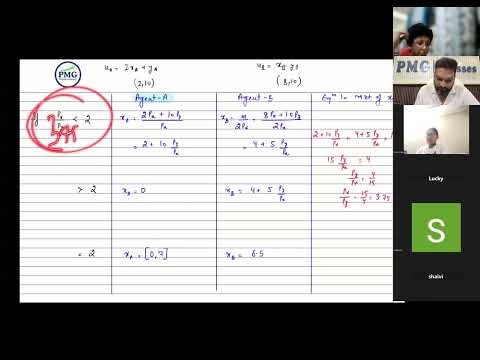
Consider two consumers, Agent A and Agent B, with the following utility functions:
The endowments for these agents are given as follows:
To analyze the market, we first need to determine the total availability of goods. In this case, the total quantity of good X is 10, and the total quantity of good Y is 20. This leads us to construct an Edgeworth box to visualize the allocation of resources.
The Edgeworth box is a graphical representation used to analyze the distribution of resources between two agents. The dimensions of the box are determined by the total quantities of goods available. In our case, the box will be rectangular, with the horizontal axis representing good X and the vertical axis representing good Y.
To find the competitive equilibrium price ratio, we need to calculate the marginal rate of substitution (MRS) for both agents. The MRS indicates the rate at which one good can be substituted for another while maintaining the same level of utility. For our utility functions:
This leads us to analyze three cases based on the price ratio (P_X/P_Y):
To establish market equilibrium, we can apply Walras' Law, which states that equilibrium in one market implies equilibrium in another. We can focus on one good's market to find the equilibrium price and quantity, which will automatically adjust the other market.
A fair allocation is one that is both Pareto efficient and equitable. Pareto efficiency occurs when no reallocation can make one individual better off without making another worse off. To determine if an allocation is fair, we must check:
To check for equity, we can set up the following conditions:
These conditions ensure that both agents are satisfied with their respective allocations.
In conclusion, understanding competitive equilibrium and fair allocation is essential for analyzing economic models. By examining utility functions, demand and supply dynamics, and the conditions for Pareto efficiency, we can gain insights into how resources are allocated in various market structures. This knowledge is crucial for policymakers and economists aiming to create equitable and efficient economic systems.