This blog post explores the concept of development accounting, which seeks to explain the disparities in wealth among countries. It discusses the role of physical capital, labor, and total factor productivity in determining a country's GDP per capita, and highlights the importance of institutions in influencing economic outcomes.
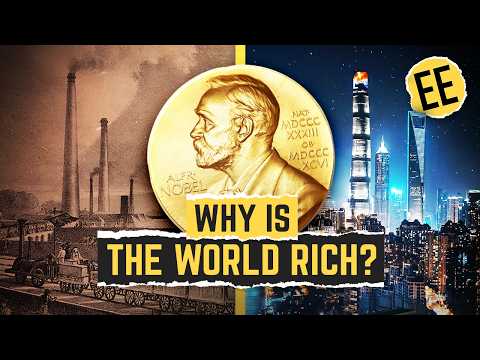
The question of why some countries are richer than others is a central theme in economics, often explored through the lens of development accounting. This field seeks to quantify the factors that contribute to differences in economic prosperity across nations. In this lecture, we will delve into the fundamental concepts of development accounting, drawing on recent Nobel Prize-winning research that addresses this very question.
Development accounting examines the variations in GDP per capita across countries. The horizontal axis of our analysis represents per capita GDP, normalized to the GDP per capita of the United States, while the vertical axis indicates the growth rate of GDP per capita. The stark differences in GDP per capita highlight the vast disparities in wealth, particularly when comparing wealthier nations like the U.S. to poorer countries in Sub-Saharan Africa, where ratios can be as low as 1:64.
To understand these disparities, economists utilize an aggregate production function, which explains how much output an economy produces based on inputs such as physical capital and labor. The function can be expressed as:
Y = A * K^α * L^β
Where:
In our analysis, we focus on the inputs of physical capital (K) and labor (L), with the understanding that the efficiency parameter (A) plays a crucial role in determining output.
The marginal productivity of capital refers to the additional output produced when one more unit of capital is added, holding other inputs constant. It is crucial to note that the MPK is decreasing as the stock of capital increases, a phenomenon known as diminishing marginal returns. This means that as more capital is added, the additional output generated from each new unit of capital becomes smaller.
Similarly, the marginal productivity of labor measures the additional output produced when one more unit of labor is added. Like capital, the MPL also experiences diminishing returns, indicating that adding more labor without increasing capital will eventually lead to lower increases in output.
Total factor productivity (A) is a critical component of the production function that captures the efficiency with which capital and labor are utilized. Differences in TFP can explain why countries with similar levels of capital and labor can have vastly different GDP per capita. For instance, countries like Japan may have a lower capital per capita compared to the U.S., but their higher TFP allows them to achieve a higher standard of living.
Recent research, including the work of Nobel Prize winners Daron Acemoglu, James Robinson, and Simon Johnson, emphasizes the importance of institutions in shaping economic outcomes. Institutions determine how effectively a country can utilize its resources, impacting everything from property rights to market regulations. Countries with strong institutions tend to have higher TFP, leading to greater economic prosperity.
A stark example of the impact of institutions can be seen in the comparison between North and South Korea. After their division post-World War II, South Korea adopted market-oriented reforms and democratic institutions, leading to significant economic growth. In contrast, North Korea's centralized, authoritarian regime has resulted in widespread poverty and underdevelopment.
In summary, development accounting provides a framework for understanding the disparities in wealth among nations. By analyzing the roles of physical capital, labor, and total factor productivity, we can gain insights into the underlying factors that contribute to economic prosperity. Furthermore, the significance of institutions cannot be overstated, as they play a pivotal role in determining how effectively a country can harness its resources for growth. As we continue to explore these concepts, it becomes clear that addressing the root causes of poverty and underdevelopment requires a multifaceted approach that considers both economic and institutional factors.