
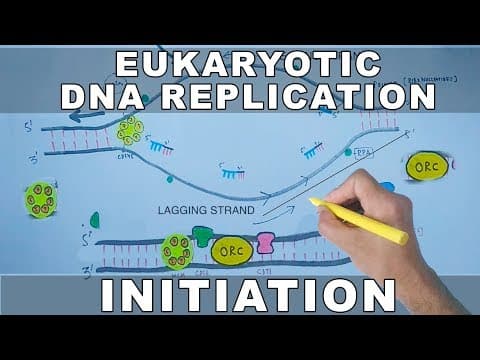
This blog post explores the intricate process of DNA replication initiation in eukaryotes, detailing the key proteins and enzymes involved, the steps of the initiation phase, and the transition from the G1 to S phase of the cell cycle.
DNA replication is a fundamental process that occurs in all living organisms, and it can be broadly categorized into two types: prokaryotic and eukaryotic. In this post, we will focus on the initiation phase of DNA replication in eukaryotes, which is a complex and highly regulated process.
The DNA replication process in eukaryotes proceeds through three major steps:
This article will provide a detailed examination of the initiation phase, which is crucial for the successful replication of the linear DNA molecule found in eukaryotic cells.
Eukaryotic DNA is characterized by its linear structure, consisting of two strands that run in opposite directions. A key feature of this structure is the origin of replication (ori site), which is a specific region where replication begins. This ori site is typically rich in adenine and thymine (A-T rich) sequences. In yeast, for example, this region is referred to as autonomously replicating sequences (ARS).
The initiation of DNA replication in eukaryotes involves several critical proteins and enzymes:
Origin Recognition Complex (ORC)
CDC6 Protein
CDT1 Protein
MCM Complex (MCM2-7)
Cyclin-Dependent Kinases (CDK) and Dbf4-Dependent Kinase (DDK)
Replication Protein A (RPA)
Replication Factor C (RFC)
DNA Polymerases
Primase
The initiation of DNA replication begins with the binding of the ORC to the ori site. The ORC then recruits CDC6 and CDT1 proteins, which facilitate the loading of the MCM helicase onto the DNA. This process occurs during the G1 phase of the cell cycle.
As the cell transitions from the G1 phase to the S phase, kinase enzymes such as CDK and DDK phosphorylate the initiation proteins, activating them. The phosphorylation of CDC6 leads to its degradation, while CDT1 is inhibited to prevent premature initiation.
The phosphorylated MCM complex is then recruited along with CDC45 and GINS proteins, forming the CMG assembly (CDC45, MCM, and GINS). This assembly moves along the DNA, unwinding it to create a template for replication.
Once the DNA is unwound, primase synthesizes RNA primers on both strands. DNA Polymerase Alpha then extends these primers by adding deoxynucleotides, providing the necessary starting point for DNA Polymerase Delta, which takes over to synthesize the leading and lagging strands.
The lagging strand is synthesized in short segments known as Okazaki fragments, which are later joined together by DNA ligase.
The initiation of DNA replication in eukaryotes is a highly coordinated process involving multiple proteins and enzymes that work together to ensure accurate and efficient replication of the genetic material. Understanding this process is crucial for insights into cell division and the maintenance of genomic integrity. In the next video, we will delve into the elongation phase of DNA replication, further expanding our understanding of this vital biological process.



















