This blog post provides a comprehensive overview of electron configuration and orbital diagrams, explaining the principles behind filling electron orbitals, the significance of quantum numbers, and practical examples using elements from the periodic table.
In this post, we will explore the concepts of electron configuration and orbital diagrams, essential topics in quantum mechanics. Understanding these concepts is crucial for grasping how electrons are arranged in atoms and how they influence chemical behavior.
Electron configuration refers to the distribution of electrons in an atom's orbitals. Electrons occupy the lowest energy levels first, following specific rules that dictate how they fill available orbitals.
Electrons fill orbitals in a specific order based on energy levels. The general order of filling is:
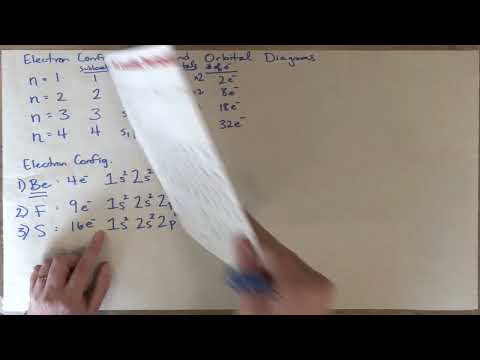
To illustrate how to write electron configurations, let’s consider a few elements:
Three key principles guide the filling of electron orbitals:
Electrons occupy the lowest energy orbitals first. This principle explains why the 1s orbital is filled before the 2s orbital.
Each orbital can hold a maximum of two electrons, which must have opposite spins. This ensures that no two electrons in an atom can have the same set of quantum numbers.
When electrons occupy orbitals of equal energy, one electron enters each orbital until all are half-filled before any orbital gets a second electron. This minimizes electron-electron repulsion and stabilizes the atom.
Orbital diagrams provide a visual representation of electron configurations. Each line represents an orbital, and arrows represent electrons. For example, the orbital diagram for manganese (Mn) with 25 electrons would look like this:
Understanding electron configuration and orbital diagrams is fundamental in chemistry and physics. By following the Aufbau principle, Pauli Exclusion principle, and Hund's rule, one can accurately determine how electrons are arranged in an atom. This knowledge not only aids in predicting chemical behavior but also lays the groundwork for more advanced studies in quantum mechanics and atomic theory.