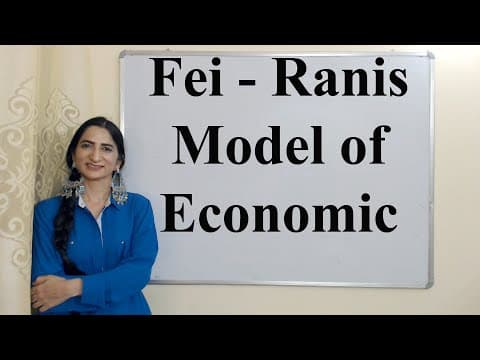
The Fei-Ranis model enhances the Lewis model by emphasizing the role of agriculture in industrial growth, outlining three stages of labor productivity and its impact on economic development.
The Fei-Ranis model, developed by economists John Fei and Gustaf Ranis, presents a refined perspective on economic development, particularly in the context of transitioning economies. This model improves upon the earlier Lewis model by highlighting the critical role of the agricultural sector in fostering growth within the industrial sector.
The Fei-Ranis model is structured around the interaction between two primary sectors in the economy: agriculture and industry. It posits that increases in productivity within the agricultural sector can significantly promote growth in the industrial sector. The model is built on several key assumptions:
The Fei-Ranis model is divided into three distinct stages, each characterized by different levels of marginal productivity of labor.
In the first stage, the marginal productivity of labor is zero. This implies that additional labor does not contribute to increased production. For example, if a piece of land requires only five workers to operate efficiently, but ten workers are employed, the additional five workers do not add any value to production.
Transferring labor from agriculture to industry during this stage does not affect agricultural output but increases industrial production, leading to overall economic development.
During the second stage, the marginal productivity of labor becomes positive but remains less than the average productivity. Workers in this stage contribute to production but are compensated with wages that exceed their marginal productivity. For instance, if the marginal productivity is ten but wages are fifteen, there is still room to transfer labor from agriculture to industry without harming agricultural output. This transfer continues to stimulate industrial growth.
In the third stage, the marginal productivity of labor exceeds the average productivity. Workers are now contributing significantly to production, and the agricultural sector has become more commercialized, producing crops for sale rather than for subsistence. At this point, the demand for labor in agriculture increases, making it challenging to transfer labor to industry without affecting agricultural output.
The model can be visually represented through diagrams that illustrate the relationships between labor, productivity, and output in both sectors.
These diagrams help clarify the transitions between the three stages and the implications for economic growth.
While the Fei-Ranis model provides valuable insights, it has faced criticism on several fronts:
The Fei-Ranis model of economic development offers a nuanced understanding of how agricultural productivity can drive industrial growth. By outlining the three stages of labor productivity, it provides a framework for analyzing economic transitions in developing economies. Despite its criticisms, the model remains a significant contribution to economic theory, emphasizing the interconnectedness of agricultural and industrial sectors in fostering overall economic development.