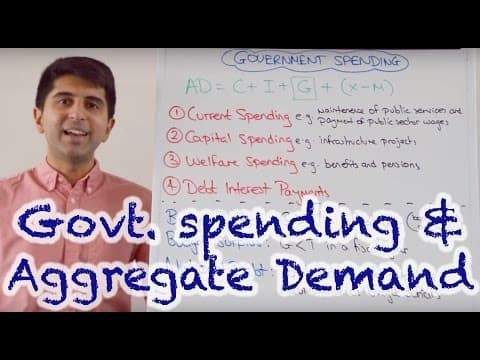
Government spending plays a crucial role in influencing aggregate demand and economic activity. This blog post explores the different types of government spending, the concepts of budget deficit and national debt, and their implications for the economy.
Government spending is a key component of the aggregate demand equation, represented as C + I + G + (X - M), where G stands for government spending. This spending is essential for influencing both short-run and long-run economic growth, making it a vital aspect of economic policy.
Government spending can be categorized into several types, each serving different purposes in the economy:
Current spending refers to expenditures on the maintenance of essential public sector services. This includes:
Capital spending involves investments in infrastructure projects that contribute to long-term economic growth. Examples include:
Welfare spending constitutes a significant portion of government expenditure, particularly in the UK. This includes:
Debt interest payments are the costs associated with servicing national debt. As many countries face rising debt levels, these payments can become substantial. In the UK, for instance, annual debt interest payments are around £50 billion, which poses a significant opportunity cost when compared to other essential services like education and healthcare.
Types of government spending that directly inject money into the economy—such as current spending, capital spending, and welfare spending—tend to shift aggregate demand to the right, stimulating economic activity. In contrast, debt interest payments do not contribute to this injection, as they represent money that is not reinvested into the economy.
Understanding government spending also requires familiarity with certain economic terms:
A budget deficit occurs when government spending exceeds tax revenues within a fiscal year. In the UK, the fiscal year runs from April to April. This deficit necessitates borrowing to cover the shortfall.
Conversely, a budget surplus arises when government spending is less than tax revenues, indicating that the government is operating within its means for that fiscal year.
National debt represents the total accumulation of past budget deficits over time. It is a stock concept, reflecting the overall debt at any given moment, as opposed to the flow concept of a budget deficit, which pertains to a single fiscal year. For example, if a government runs a budget deficit for five consecutive years, this will significantly increase the national debt.
In summary, government spending is a fundamental driver of economic activity, influencing aggregate demand through various channels. Understanding the distinctions between current spending, capital spending, welfare spending, and debt interest payments is crucial for grasping how government actions impact the economy. Additionally, recognizing the differences between budget deficits and national debt helps clarify the long-term implications of fiscal policy decisions.
Stay tuned for the next discussion, where we will explore the determinants of net exports and their role in the economy.