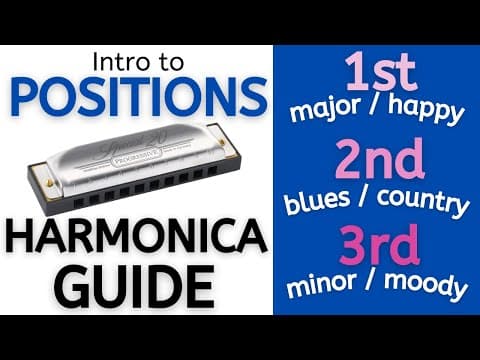
This blog post explains the concept of harmonica positions, focusing on the 1st, 2nd, and 3rd positions. It details how these positions relate to the keys of the harmonica and the music being played, providing insights into playing major and minor scales, particularly in blues music.
Harmonica playing can often be confusing, especially when it comes to understanding the concept of positions. In this guide, we will simplify the idea of harmonica positions, focusing on the 1st, 2nd, and 3rd positions, and how they relate to the keys of the harmonica and the music you want to play.
Harmonica positions refer to the relationship between the key of the harmonica and the key of the music being played. Diatonic harmonicas, like the common C harmonica, are designed to play in a specific major key. For example, a C harmonica plays in C major. However, musicians often want to play in different keys or scales, which is where the concept of positions becomes useful.
While most instruments can play in any key, diatonic harmonicas are limited to their designated key. To play in other keys, musicians can either purchase multiple harmonicas or utilize their knowledge of music theory to play in different positions. This allows for greater flexibility, especially when playing minor scales or blues music.
First position is the simplest and most straightforward. It involves playing in the home key of the harmonica itself. For a C harmonica, this means playing in the key of C.
In first position, players can easily create melodies using the major scale, which is centered in the middle of the harmonica.
Second position, also known as cross harp, is commonly used for playing blues music. When using a C harmonica, second position allows you to play in the key of G.
This position is particularly effective for creating a bluesy sound, as it introduces tension between major and minor notes, making it easier to play blues licks.
Third position is primarily used for playing in minor keys. On a C harmonica, this position corresponds to the key of D.
This position allows players to create darker, more expressive melodies, making it ideal for songs like "Summertime."
To determine the position you are playing in, you can use the circle of fifths. This diagram illustrates the relationships between different keys. For example:
This relationship helps players understand which positions are easier to play based on their proximity to the home key. Positions further away from the home key tend to be more challenging due to fewer shared notes.
Understanding harmonica positions is essential for any player looking to expand their musical repertoire. By mastering the 1st, 2nd, and 3rd positions, you can play in various keys and explore different musical styles, particularly major and minor scales. For those interested in delving deeper into harmonica positions, additional resources and courses are available to enhance your learning experience.
Feel free to explore the free summary linked below for a comprehensive overview of all 12 positions across different keys of harmonica. Happy playing!