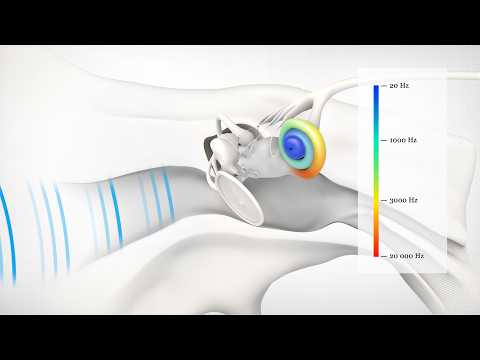
This article explores the scientific process of hearing, explaining how sound waves travel through the ear, are converted into electrical signals, and processed by the brain. It covers the anatomy of the ear, the auditory pathway, and how the brain localizes and interprets sounds, including speech processing, highlighting that our perception creates the acoustic world we experience.
Does a falling tree make a sound if no one is listening? This classic philosophical question touches on whether our perception creates the world around us. Scientifically, hearing requires a carrier medium, usually air, through which sound waves—tiny fluctuations in air pressure—propagate. When these sound waves reach an ear, there is a good chance the event will be perceived.
Hearing begins with the outer ear, which helps localize the source of sound and acts like a funnel directing sound waves into the auditory canal. These waves cause the tympanic membrane (eardrum) to vibrate.
The vibrations from the eardrum are absorbed by the smallest bones in the body: the malleus, incus, and stapes. These bones transmit the vibrations to the oval window, a membrane-covered opening to the inner ear.
Behind the oval window lies the cochlea, a spiral-shaped organ where sound waves travel along the basilar membrane. This membrane varies in stiffness: it is very stiff at the base, processing high frequencies, and becomes more flexible towards the apex, processing low frequencies.
On the basilar membrane lies the organ of Corti, which contains hair cells. Above these hair cells is the tectorial membrane. The vibration of the basilar membrane causes relative movement between the hair cells and the tectorial membrane, converting mechanical stimuli into electrical signals.
The electrical signals generated by hair cells are transmitted via auditory nerve fibers, which form the cochlear nerve, to the brainstem. The first neuronal processing stations are the cochlear nuclei, which process signals from the same side ear.
Signals then reach the superior olivary complex, which calculates the position of the sound source. It can detect time differences as small as 0.6 milliseconds between the right and left ears to localize sound.
All signals are processed in the two inferior colliculi. Here, information from the vestibular system (balance) and the eyes also plays a role, integrating multiple sensory inputs.
The auditory pathway continues to the medial geniculate body of the thalamus. Neurons here send axons forming the auditory radiation, which transports information to the primary auditory cortex.
The primary auditory cortex is organized tonotopically, meaning it is arranged according to sound frequency. Its main tasks are sound differentiation and localization.
Further processing occurs in the secondary and tertiary auditory cortex, where information from memory and other sensory systems is integrated.
An important aspect of human hearing is speech processing, involving the Wernicke's area (Vernica center). This area helps interpret and understand spoken language.
While sound exists as physical waves, the acoustic world we experience is created through perception. The complex journey from sound waves traveling through the ear to intricate brain processing highlights how our auditory system enables us to interpret and interact with our environment.