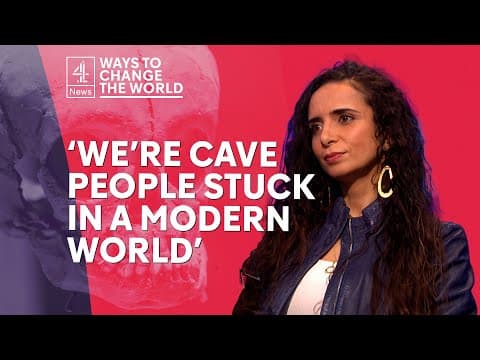
Ella Al-Shamahi, an evolutionary biologist, discusses the complexities of human evolution, the impact of modern life on our species, and her personal journey from a creationist to a scientist. She emphasizes the importance of cooperation in human success and the challenges posed by our current environment, which is vastly different from the one we evolved in.
Studying human evolution reveals the resilience and complexity of our species. Ella Al-Shamahi, a paleoanthropologist and evolutionary biologist, shares her insights on the evolution of Homo sapiens, the impact of modern life on our species, and her personal journey from a creationist to a scientist. This blog post delves into her thoughts on human evolution, cooperation, and the challenges we face in today's world.
Ella Al-Shamahi defines a paleoanthropologist as someone who studies deep time, focusing on early civilizations and the origins of humanity. Unlike archaeologists who may study more recent historical periods, paleoanthropologists explore the distant past, piecing together the story of human evolution from limited remains and evidence.
Al-Shamahi emphasizes the difficulty of reconstructing human history due to the scarcity of remains. She notes that while many narratives about our past are presented with certainty, they often contain qualifiers like "maybe" and "perhaps." The advent of ancient DNA analysis has revolutionized the field, allowing scientists to answer long-debated questions, such as whether Neanderthals and Homo sapiens interbred.
One of the most exciting aspects of Al-Shamahi's work is the portrayal of the diverse human species that once coexisted on Earth. For hundreds of thousands of years, multiple human species, including Homo erectus and Neanderthals, shared the planet. This diversity challenges the traditional understanding of human taxonomy and species classification.
Al-Shamahi introduces the fascinating example of Homo floresiensis, often referred to as the "Hobbit." This small human species, standing about three feet tall, lived on an island in Indonesia alongside giant animals. Their existence highlights the incredible variety of human forms and adaptations throughout history.
When discussing why Homo sapiens emerged as the dominant species, Al-Shamahi presents several theories. Contrary to the common belief that brain size was the key factor, she argues that cooperation and friendliness among individuals played a crucial role in our success. This perspective challenges the notion that intelligence alone determined our survival.
Al-Shamahi posits that our species' ability to cooperate and form social bonds was a significant advantage. This hyper-cooperative nature allowed early humans to thrive in ways that other species could not. In today's political climate, she believes this message is particularly relevant, as cooperation remains essential for addressing global challenges.
Al-Shamahi expresses concern that modern life is not conducive to our evolutionary design. Humans evolved in small tribes, primarily in caves, where social structures were vastly different from today's urban environments. The rapid technological advancements of the last few centuries have created a world that our ancestors were not prepared for, leading to various societal issues.
While acknowledging the benefits of modern advancements, such as art and creativity, Al-Shamahi highlights the trade-offs that come with them. The disconnect between our evolutionary past and present circumstances has resulted in challenges that can be traced back to our cave-dwelling ancestors.
Al-Shamahi argues that human evolution is slowing down due to advancements in medicine and technology. Natural selection, which once played a significant role in shaping our species, is now less impactful as scientific interventions allow individuals with conditions that would have previously hindered reproduction to have children.
She asserts that human behavior has halted evolution in many ways, as societal norms and technological solutions mitigate the pressures that would typically drive natural selection. This raises questions about the future trajectory of our species and whether we will adapt to the modern world.
Al-Shamahi's own journey is a compelling narrative of transformation. Raised in a conservative Muslim community that rejected evolution, she initially sought to disprove evolutionary theory. However, her studies led her to embrace evolution, resulting in a profound personal and ideological shift.
Her transition was not easy; it involved leaving behind a community and a worldview that had shaped her identity. Al-Shamahi reflects on the emotional turmoil of reconciling her scientific beliefs with her upbringing, emphasizing the importance of personal growth and resilience.
Al-Shamahi warns of the growing polarization in society, particularly regarding science. She believes that the current climate of distrust in scientific authority poses a significant threat to progress. The tribal nature of belief systems can lead individuals to reject scientific consensus in favor of their community's views.
To combat this polarization, Al-Shamahi advocates for open dialogue and the inclusion of diverse perspectives in scientific discussions. She emphasizes the importance of recognizing biases within both left-leaning and right-leaning communities to foster a more inclusive scientific environment.
Ella Al-Shamahi's insights into human evolution and her personal journey highlight the complexities of our species' past and present. As we navigate the challenges of modern life, understanding our evolutionary history can provide valuable context for addressing contemporary issues. By fostering cooperation and open dialogue, we can work towards a future that honors our shared humanity while embracing the diversity of thought that enriches our understanding of the world.