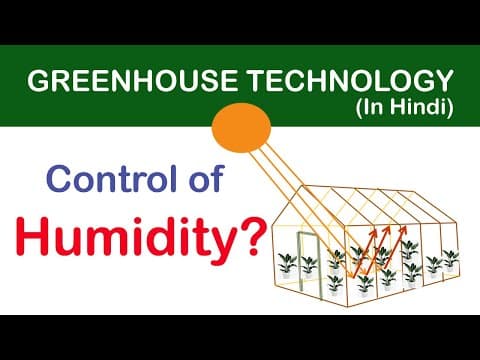
This blog post explores the importance of humidity control in greenhouses, detailing the concepts of absolute humidity, relative humidity, and vapor pressure deficit (VPD). It discusses how these factors affect plant health and growth, and provides practical methods for maintaining optimal humidity levels in greenhouse environments.
Humidity control is a critical aspect of greenhouse management that directly impacts plant health and productivity. This blog post delves into the essential concepts of humidity, including absolute humidity, relative humidity, and vapor pressure deficit (VPD), and discusses effective strategies for maintaining optimal humidity levels in greenhouses.
Humidity refers to the amount of water vapor present in the air. It can be expressed in various forms, primarily through absolute humidity and relative humidity.
Absolute humidity is defined as the mass of water vapor present in a given volume of air, typically measured in grams per cubic meter (g/m³). For example, if the absolute humidity is 20 g/m³, it indicates that there are 20 grams of water vapor in one cubic meter of air. This measurement is crucial for understanding how much moisture is available in the air for plant uptake.
Relative humidity (RH) is the percentage of water vapor present in the air compared to the maximum amount of water vapor that the air can hold at a specific temperature and pressure. It is calculated by taking the current absolute humidity and dividing it by the maximum possible humidity at that temperature, then multiplying by 100.
For instance, at 20 degrees Celsius, if the air can hold a maximum of 30 g/m³ of water vapor and the current absolute humidity is 15 g/m³, the relative humidity would be 50%.
As temperature increases, the capacity of air to hold moisture also increases, leading to a decrease in relative humidity if the absolute humidity remains constant. Conversely, as temperature decreases, relative humidity increases.
Different plants have varying humidity requirements for optimal growth. For example, tomatoes thrive at a relative humidity of 50-60%, while peppers prefer 60-65%. Maintaining the right humidity levels is essential to prevent issues such as fungal growth and water stress in plants.
Vapor pressure deficit is the difference between the amount of moisture in the air and how much moisture the air can hold when saturated. VPD is a critical factor in plant transpiration and overall health. A VPD of 0.8 to 2.1 kPa is generally ideal for most plants, as it promotes healthy growth without causing excessive water loss.
As temperatures rise, the VPD increases, which can lead to higher transpiration rates. This means that plants may need to absorb more water to maintain their health, making it essential to monitor and adjust humidity levels accordingly.
Effective humidity control in greenhouses can be achieved through several methods:
Evaporative cooling systems are commonly used in greenhouses to increase humidity. These systems work by passing air through wet pads, which cools the air and adds moisture. This method is particularly effective in hot climates where maintaining humidity is challenging.
Regular watering not only provides plants with necessary moisture but also increases humidity levels in the greenhouse. Additionally, creating water bodies or using water features can enhance evaporation, further raising humidity.
There are various products available in the market designed to increase humidity levels in greenhouses. These products often involve heating water to create vapor, which is then distributed throughout the greenhouse.
Proper ventilation is crucial for managing humidity levels. By allowing fresh air to circulate, excess moisture can be expelled, preventing the buildup of humidity that can lead to fungal diseases.
Regular monitoring of humidity levels using hygrometers is essential. Adjustments can be made based on the readings to ensure that the environment remains conducive to plant growth.
Humidity control is vital for successful greenhouse management. Understanding the concepts of absolute humidity, relative humidity, and vapor pressure deficit allows growers to create optimal conditions for plant health. By implementing effective humidity management strategies, greenhouse operators can enhance plant growth, reduce disease risks, and ultimately improve yields.