This blog post provides an in-depth overview of hydrocarbons, focusing on alkanes and alkenes, their properties, extraction methods, reactions, and environmental impacts. It covers the processes of fractional distillation, cracking, combustion, and the formation of halogenoalkanes, along with the implications of incomplete combustion and pollution.
Hydrocarbons are organic compounds made up solely of hydrogen and carbon atoms. They are fundamental to organic chemistry and are categorized into two main types: alkanes and alkenes. This blog post will explore the properties, extraction methods, reactions, and environmental impacts of these hydrocarbons, particularly focusing on alkanes and alkenes.
Alkanes are saturated hydrocarbons, meaning they contain no double bonds. Their general formula is C_nH_(2n+2). Each carbon atom in an alkane is bonded to four other atoms, resulting in a stable structure. Common examples include methane (CH₄), ethane (C₂H₆), and propane (C₃H₈).
Cycloalkanes are a subset of alkanes where the carbon atoms are arranged in a ring structure. They still follow the saturation rule and have the general formula C_nH_(2n). For instance, cyclopentane (C₅H₁₀) is a cycloalkane with five carbon atoms.
Alkanes are primarily found in crude oil and natural gas. Crude oil is a complex mixture of hydrocarbons, and alkanes can be extracted through a process called fractional distillation. This process involves heating crude oil to separate it into different fractions based on boiling points.
In fractional distillation, crude oil is vaporized and passed through a fractionating column. The column has a temperature gradient, allowing different hydrocarbons to condense at various heights based on their boiling points. Longer-chain hydrocarbons condense at higher temperatures and lower in the column, while shorter-chain hydrocarbons rise to the top.
The distillation process yields various products, including:
Sometimes, the fractions obtained from crude oil do not meet consumer demand. For instance, if a large quantity of heavy fractions like bitumen is produced, there may be a shortage of lighter fractions like petrol. To address this, a process called cracking is employed.
Alkanes are commonly used as fuels due to their ability to undergo complete combustion in the presence of oxygen, producing carbon dioxide and water. For example, the complete combustion of butane (C₄H₁₀) can be represented as:
C₄H₁₀ + 6.5 O₂ → 4 CO₂ + 5 H₂O
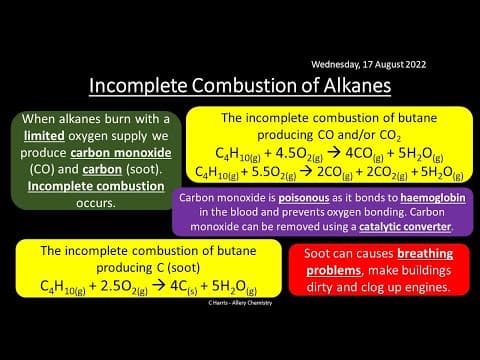
In reality, complete combustion is rare. Incomplete combustion occurs when there is insufficient oxygen, leading to the production of carbon monoxide (a poisonous gas) and soot (carbon). This can have serious health implications, as carbon monoxide binds to hemoglobin in the blood, preventing oxygen transport.
The combustion of hydrocarbons contributes to air pollution, producing harmful gases such as nitrogen oxides and sulfur dioxide, which can lead to respiratory issues and environmental problems like acid rain and photochemical smog.
To mitigate these effects, vehicles are equipped with catalytic converters that convert harmful gases like carbon monoxide and nitrogen oxides into less harmful substances before they are released into the atmosphere.
Alkenes are unsaturated hydrocarbons that contain at least one double bond, following the general formula C_nH_(2n). They are more reactive than alkanes due to the presence of the double bond.
Alkenes undergo various reactions, primarily addition reactions, where new atoms or groups are added to the carbon atoms involved in the double bond. Key reactions include:
Alkenes react with electrophiles, which are electron-deficient species. The double bond's high electron density attracts these electrophiles, leading to the formation of carbocation intermediates during reactions.
Hydrocarbons, including alkanes and alkenes, play a crucial role in our daily lives, serving as fuels and raw materials for various industries. Understanding their properties, reactions, and environmental impacts is essential for responsible usage and management of these vital resources. As we move towards more sustainable energy sources, the knowledge of hydrocarbons will remain relevant in the ongoing discussions about energy and environmental conservation.