Despite continuous regional conflicts, Israel has maintained a high GDP per capita through U.S. support, a robust defense industry, and a focus on innovation and human capital. However, rising military costs and political complexities pose challenges to its economic stability.
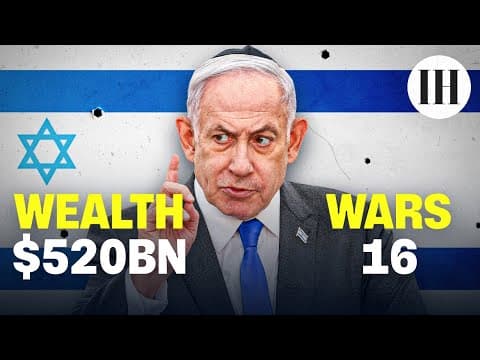
Israel is often viewed as one of the most controversial and perplexing nations globally. For over 40 years, it has been embroiled in continuous regional conflicts, yet it has managed to emerge as one of the wealthiest and most prosperous countries in the world. As of 2023, Israel's GDP per capita stands at approximately $52,000, significantly higher than all its neighboring countries combined and comparable to some of Europe's richest nations. This raises an intriguing question: how does Israel maintain such economic strength despite being in a state of perpetual conflict?
Typically, war leads to economic decline, destruction, and resource depletion. However, Israel's situation appears to defy this norm. Even amidst escalating tensions, such as the recent conflict in Gaza, the Israeli stock market has surged by 22% this year, reaching record highs. This anomaly can be attributed to several unique advantages that Israel possesses.
One of the most significant factors contributing to Israel's economic resilience is its unwavering support from the United States. Since the late 1960s, the U.S. has provided Israel with over $251 billion in military and economic assistance. In the previous year alone, this aid accounted for more than half of all U.S. foreign assistance. The diplomatic backing from the U.S. often shields Israel from sanctions or resolutions at the United Nations that could inflict severe economic damage. While Israel could defend itself without U.S. support, it would struggle to maintain its current level of economic activity without this protection.
Israel's economy has been strategically designed to thrive under wartime conditions. Since its inception, the defense industry has been deeply integrated into the national economy, evolving into one of the world's leading exporters of military technology. In 2023, defense exports reached a record $113 billion, positioning Israel among the top exporters in the global defense market. This unique relationship between military needs and economic growth has allowed Israel to turn conflict into an engine for economic expansion.
Despite the economic benefits derived from its defense sector, the rising military expenditures—now accounting for around 10% of GDP—have begun to strain public finances. Political considerations complicate budgetary decisions, particularly for Prime Minister Benjamin Netanyahu, who has resisted cutting subsidies for ultra-Orthodox communities or scaling back funding for religious schools, despite the increasing defense budget. This delicate balance between military spending and social services is critical to maintaining public support.
To understand how Israel has achieved its current economic status, it is essential to consider its historical context. Founded in 1948, Israel faced immediate military threats from neighboring countries, which diverted resources towards defense and stunted growth in other sectors. Major conflicts, such as the Six-Day War in 1967 and the Yom Kippur War in 1973, while damaging, also spurred rapid advancements in military technology.
By the 1980s, Israel faced a severe economic crisis, which prompted a shift towards privatization and foreign investment. This transition attracted significant foreign capital, particularly from Western nations that viewed Israel as a stable and democratic partner in a volatile region. The government implemented tax breaks and zero-interest loans to stimulate investment in high-tech industries, leading to the establishment of research centers for major companies like Intel and Google.
Israel's focus on innovation is not merely a strategy for economic growth; it is a matter of survival. The constant security threats have necessitated technological advancements, which often spill over into civilian markets. For instance, Israel's cybersecurity sector, initially driven by defense needs, generated over $1 billion in exports in 2023 alone. This dual-use nature of technology has allowed defense investments to fuel startup growth and attract foreign investment, transforming potential financial burdens into key economic drivers.
A significant factor in Israel's economic success is its investment in human capital. The country allocates around 5% of its GDP to research and development, double the rate of the United States. The influx of nearly a million skilled immigrants from the former Soviet Union in the 1990s further bolstered Israel's workforce, transforming it into a tech powerhouse.
Mandatory military service plays a crucial role in this dynamic. Nearly every Israeli serves in the army, gaining hands-on experience with advanced technology and leadership skills. Veterans, particularly those from elite units, transition seamlessly into civilian roles, driving growth in the high-tech sector. This integration of military training into the workforce creates a concentrated pool of expertise that fuels innovation and economic expansion.
Despite its robust economic framework, Israel faces significant challenges. The ongoing conflict has led to increased military costs, with estimates suggesting that the war could cost over $70 billion in the coming years. The budget deficit is projected to rise from 4.6% of GDP to as much as 10%, and the economy contracted by 19.8% on an annualized basis in the last quarter of 2023. Consumer spending has dropped by 27%, and private investment has plummeted by 70% in key sectors.
As the government grapples with these pressures, the unwritten social contract between the state and its citizens is at risk. Historically, the public has tolerated the costs of conflict as long as their quality of life remains relatively stable. However, rising military expenditures could threaten social services and living standards, potentially eroding public support for the government's approach.
Political factors further complicate the situation. Netanyahu's coalition relies on ultra-Orthodox parties, making it politically sensitive to cut subsidies or reduce funding for religious schools. This could lead to difficult decisions regarding austerity measures, tax hikes, or cuts to public assistance.
Israel's ability to maintain economic stability amidst ongoing conflict is a testament to its unique advantages, including U.S. support, a thriving defense industry, and a commitment to innovation. However, as military costs rise and political complexities increase, the challenge lies in balancing economic growth with the social contract that has long sustained public support. The future will depend on the government's ability to make tough decisions that ensure both economic resilience and the well-being of its citizens.