This blog post provides a detailed exploration of laser fundamentals, including the definition of lasers, their components, the principles of operation, and the differences between bulk and semiconductor lasers. It covers key concepts such as gain medium, optical resonators, longitudinal and transverse modes, and the dynamics of laser operation.
In this blog post, we will delve into the basics of lasers, focusing on their fundamental principles and components. Whether you are familiar with laser technology or new to the subject, this overview will help clarify the essential concepts.
A laser is defined as a source of coherent monochromatic radiation in the optical region of the electromagnetic spectrum, typically ranging from approximately 0.2 micrometers to 20 micrometers. The term "laser" stands for Light Amplification by Stimulated Emission of Radiation. This means that lasers amplify light through a process that involves stimulated emission.
Every laser, regardless of its type, consists of three essential components:
The gain medium is crucial for the laser's operation. When the medium is pumped sufficiently, it creates a population inversion, where more atoms are in an excited state than in the ground state. This condition is necessary for stimulated emission to occur, leading to light amplification.
The optical resonator is formed by mirrors or reflective surfaces that allow light to bounce back and forth through the gain medium. This feedback is essential for building up the intensity of the laser light. The resonator also determines the modes of the laser, which are the specific frequencies of light that can be amplified.
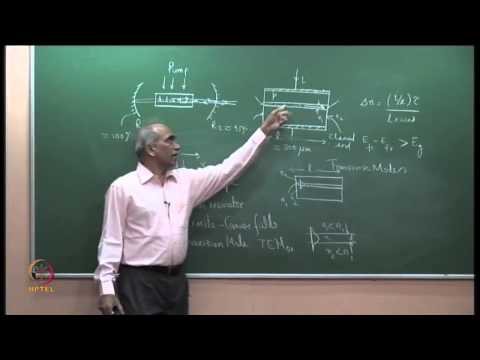
Bulk lasers, such as Nd:YAG lasers, typically have an active medium that is pumped externally, often using flash lamps or other lasers. The active medium is placed inside an optical resonator formed by mirrors with high reflectivity. The light generated in the gain medium travels back and forth, gaining intensity with each pass.
Semiconductor lasers have a different structure. They consist of a p-n junction where current flows through the active medium. When the current is sufficiently high, it leads to population inversion and light amplification. The optical feedback in semiconductor lasers is achieved through the cleaved ends of the semiconductor, which act as mirrors with a certain reflectivity.
The basic theory of laser operation can be summarized by the equation: Gain = Loss. This means that for a laser to operate, the gain provided by the active medium must exceed the losses incurred in the resonator.
When the gain exceeds the loss, the laser can start oscillating, producing a coherent beam of light.
Lasers support two types of modes:
The longitudinal modes are determined by the length of the resonator and the speed of light in the medium. Only certain frequencies will resonate, leading to discrete frequencies in the laser output.
Transverse modes describe how the laser beam's intensity is distributed across its cross-section. The fundamental mode is typically Gaussian, while higher-order modes can have more complex distributions.
In summary, understanding the fundamentals of lasers involves grasping the concepts of gain media, optical resonators, and the dynamics of laser operation. Both bulk and semiconductor lasers operate on these principles, albeit with different structures and mechanisms. The interplay between gain and loss, as well as the characteristics of longitudinal and transverse modes, is crucial for the effective functioning of lasers. In future discussions, we will explore semiconductor lasers in more detail, including their structures and designs.