This blog post explores the macroeconomic definitions of national wealth and income, explaining how they relate to individual concepts of wealth and income. It discusses the decomposition of national wealth into private and public wealth, the significance of GDP as a measure of income, and the implications of capital and labor income shares in understanding economic inequality.
In this blog post, we will delve into the macroeconomic definitions of wealth and income, building on the foundational concepts of income, wealth, and capital introduced in earlier discussions. This exploration will provide insights into how these concepts apply at the national level, enhancing our understanding of economic inequality and poverty.
National wealth is defined as the total sum of all wealth and capital owned by residents and governments of a country at a specific point in time. For instance, in the context of the United States, national wealth encompasses the value of all apartment buildings, factories, financial portfolios, and patents owned by U.S. residents and the government.
National wealth can be decomposed into two main categories:
The total national wealth in developed countries, including the U.S., is measured in hundreds of trillions of dollars, with the majority being private wealth. This highlights the significant role that private individuals and businesses play in the overall economic landscape.
National wealth can also be categorized based on the location of the capital:
Interestingly, the net foreign capital tends to be close to zero, indicating that the amount of capital owned by U.S. individuals abroad is roughly equal to the capital owned by foreign individuals in the U.S. This balance is often a politically charged topic but reflects the interconnectedness of global economies.
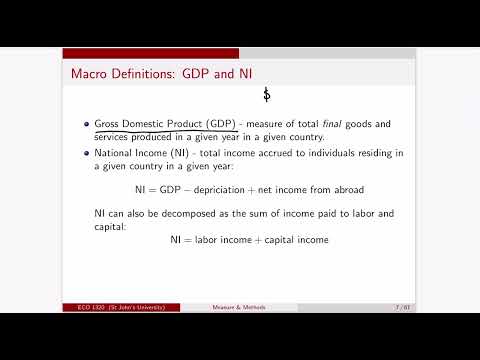
To extend the concept of individual income to the macroeconomic level, we turn to Gross Domestic Product (GDP). GDP is defined as the dollar measure of the total final goods and services produced in a country within a given year. For example, the U.S. GDP in 2022 was approximately $25 trillion.
While GDP is commonly understood as a measure of output, it is equally important to view it as a measure of income. This dual perspective allows us to understand how economic output translates into income for individuals and businesses. Theoretically, the total expenditures in an economy should equal the total income generated, as every expenditure represents income for someone else.
To derive national income from GDP, several adjustments must be made:
National income can be divided into two primary sources:
The capital share of income, denoted as Alpha, represents the proportion of national income that is derived from capital income. This value ranges between zero and one, indicating the percentage of total national income attributed to capital. For instance, if capital income is $13 trillion out of a total national income of $23 trillion, the capital share would be approximately 57%.
Conversely, the labor share of income can be derived by subtracting the capital share from one. This decomposition is crucial for understanding income inequality, as it highlights the distribution of income between labor and capital.
The capital income ratio is defined as the ratio of total capital stock to national income. This ratio provides insight into the relative importance of wealth in the economy. A higher capital income ratio indicates a greater amount of capital relative to the size of the economy, suggesting significant wealth inequality.
This ratio serves as a measure of how wealth is distributed in relation to economic output. A high ratio indicates that wealth inequality is pronounced, as it reflects the concentration of capital ownership among a small segment of the population.
In summary, understanding macroeconomic definitions of national wealth and income is essential for analyzing economic inequality and poverty. By exploring the components of national wealth, the dual nature of GDP as both output and income, and the decomposition of national income into labor and capital shares, we gain valuable insights into the dynamics of the economy. These concepts not only enhance our comprehension of economic structures but also inform discussions on policy and social equity.