This blog post explores the fundamental concepts of Mendelian genetics as established by Gregor Mendel, including key terms, laws of inheritance, and practical applications of Punnett squares in predicting genetic outcomes.
In this blog post, we will delve into the foundational concepts of genetics as established by Gregor Mendel, a monk whose pioneering work laid the groundwork for modern genetics. Despite being overlooked during his lifetime, Mendel's experiments with pea plants revealed essential principles of inheritance that continue to influence the field today.
Gregor Mendel is often referred to as the father of genetics. He conducted his groundbreaking research in a monastery where he cultivated pea plants to study their characteristics. By breeding these plants, Mendel was able to observe how traits were passed from one generation to the next, leading to the formulation of what we now call Mendelian genetics.
Before we dive deeper into Mendelian genetics, it is essential to understand some basic terms:
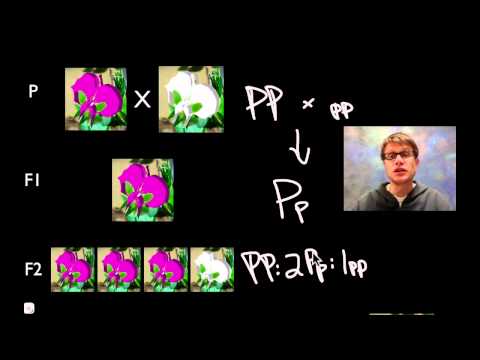
Mendel's experiments began with true-breeding pea plants, which consistently produced offspring with the same traits. He crossed purple-flowered plants (homozygous dominant) with white-flowered plants (homozygous recessive). The first generation (F1) produced only purple flowers, which seemed to support the blending theory of inheritance.
However, Mendel took his research further by allowing the F1 generation to self-pollinate. The resulting second generation (F2) exhibited a 3:1 ratio of purple to white flowers, indicating that the white trait had not disappeared but was instead masked by the dominant purple trait. This led Mendel to conclude that traits are inherited as discrete units, which we now refer to as genes.
Mendel formulated two key laws based on his observations:
This law states that each organism carries two alleles for each trait, one inherited from each parent. During gamete formation, these alleles segregate so that each gamete carries only one allele for each trait. This can be likened to flipping a coin, where there is a 50% chance of inheriting either allele.
Mendel's second law posits that the inheritance of one trait does not affect the inheritance of another. For example, the gene for flower color (purple or white) segregates independently from the gene for seed shape (round or wrinkled). This principle holds true unless genes are located close together on the same chromosome, in which case they may be inherited together.
Punnett squares are a valuable tool for visualizing genetic crosses and predicting the probability of offspring inheriting particular traits. To create a Punnett square, one lists the possible gametes from each parent along the top and side of a grid, then fills in the squares to show potential genotypes of the offspring.
Consider a cross between a purple-flowered plant (Pp) and a white-flowered plant (pp). The Punnett square would look like this:
| P | p | |
|---|---|---|
| p | Pp | pp |
| p | Pp | pp |
From this cross, we can see that 50% of the offspring will be purple (Pp) and 50% will be white (pp).
For a dihybrid cross, such as yellow round seeds (YYRR) crossed with green wrinkled seeds (yyrr), the Punnett square becomes more complex. The resulting offspring can be analyzed to determine the phenotypic ratios of the traits involved.
Mendel's work established the foundation for our understanding of genetics and inheritance. His principles of segregation and independent assortment provide a framework for predicting genetic outcomes in various organisms. As we continue to explore genetics, we will encounter more advanced concepts beyond Mendelian genetics, but the principles he laid down remain crucial to the field.
In future discussions, we will delve into non-Mendelian genetics and explore how these principles apply to more complex inheritance patterns.