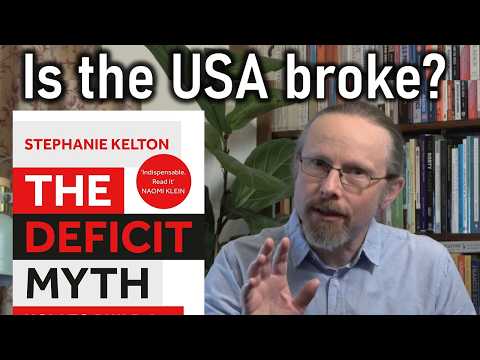
Stephanie Kelton's 'The Deficit Myth' challenges traditional views on government debt and spending through the lens of Modern Monetary Theory (MMT), arguing that fears over federal debt are misplaced and that governments can create money to fund spending without the constraints of a household budget analogy. The book emphasizes the importance of managing resources to prevent inflation rather than focusing solely on deficits.
In recent years, concerns about national debt have surged, with many fearing that America is on the brink of financial collapse. However, Stephanie Kelton's book, The Deficit Myth, presents a compelling argument rooted in Modern Monetary Theory (MMT) that challenges these fears. This article unpacks the key concepts from Kelton's work and explores the implications of MMT for understanding government spending and debt.
Kelton structures her book around a series of myths that contribute to the broader deficit myth. One of the most prevalent misconceptions is the analogy that likens government budgeting to household budgeting. This analogy suggests that just as households must earn money before they can spend it, governments must first tax or borrow before they can spend. Kelton cites Margaret Thatcher's famous quote to illustrate this viewpoint: "The state has no source of money other than the money people earn themselves."
Kelton argues that this household budgeting myth is not only misleading but also convenient for politicians advocating for austerity measures. The idea that governments must first collect taxes or borrow money before spending ignores the reality of how fiat currencies operate. Countries like the United States, the United Kingdom, and Japan, which have financial sovereignty over their own currencies, can create money as needed.
As former Federal Reserve Chair Ben Bernanke noted, the money spent by the Fed is not tax money; rather, it is created digitally, akin to printing money. Thus, the correct sequence is not tax and borrow before spending, but rather spend and then potentially tax or borrow.
Kelton emphasizes that government debt should not be viewed through the same lens as personal debt. When the government spends, it injects money into the economy, creating a deficit in its accounts. For instance, if the government spends $100 and taxes back $90, it leaves a $10 deficit. Over time, these annual deficits accumulate to form the national debt, which currently stands at approximately $34 trillion in the U.S.
An important concept introduced by Kelton is that government debt enables the non-government sector to have a surplus. In her analogy, the government sector being in debt allows the private sector to be in the black. This relationship suggests that fiscal surpluses can actually drain money from the economy, potentially leading to economic downturns. Historical evidence supports this, as periods of significant debt repayment have often coincided with economic depressions.
Kelton distinguishes between two types of dollars in the economy: green dollars (money created by the central bank) and yellow dollars (government debt instruments). While the Treasury can issue debt, it is the central bank that creates new money. This separation is crucial for understanding how government debt operates within the economy.
The central bank can buy government debt from the market, effectively converting yellow dollars into green dollars. This process has been evident in Japan, where a significant portion of national debt is owed to the Bank of Japan, illustrating how central banks can manage debt levels through monetary policy.
A central concern regarding MMT is the potential for inflation. Kelton references a conversation between President John F. Kennedy and economist James Tobin, where they concluded that the only real limit to deficits is inflation. The challenge lies in managing resources to ensure that increased money supply does not lead to excessive inflation.
Kelton argues that the focus should not be on how to pay for government spending but rather on how to resource it effectively. The key is to match increased demand from government spending with an adequate supply of goods and services to prevent inflation from rising.
Despite its growing popularity, MMT faces criticism. Some economists argue that it lacks a solid theoretical foundation and is merely a rebranding of Keynesian economics. Critics also express concerns about the potential dangers of MMT, particularly regarding inflation and fiscal discipline.
However, Kelton contends that deficits do matter, but not in the conventional sense. Excessive spending is evidenced by inflation, not merely by the size of the deficit. The challenge is to avoid inflationary pressures while maintaining sustainable levels of government spending.
Kelton's The Deficit Myth serves as a critical examination of long-held beliefs about government spending and debt. It challenges the notion that balanced budgets are necessary for economic stability and highlights the importance of understanding the true mechanics of fiat currency systems. As societies face complex challenges such as climate change and technological disruption, reimagining economic models may be essential for navigating future crises.
In summary, countries that issue their own currency can afford to run deficits, and austerity measures may be more harmful than beneficial. The insights from MMT encourage a reevaluation of economic policies and the myths that have shaped them, paving the way for more informed discussions about fiscal responsibility and economic health.