This blog post explains the concept of monetary policy, focusing on the Reserve Bank of India's (RBI) role in regulating banks and controlling money supply and interest rates to manage inflation and economic stability.
Monetary policy is a crucial aspect of any economy, influencing everything from inflation rates to the availability of loans. In this post, we will explore what monetary policy is, how it functions in India, and the role of the Reserve Bank of India (RBI) in regulating the banking system.
Monetary policy refers to the actions undertaken by a country's central bank to control the money supply and interest rates in the economy. The primary goal of monetary policy is to achieve macroeconomic objectives such as controlling inflation, consumption, growth, and liquidity.
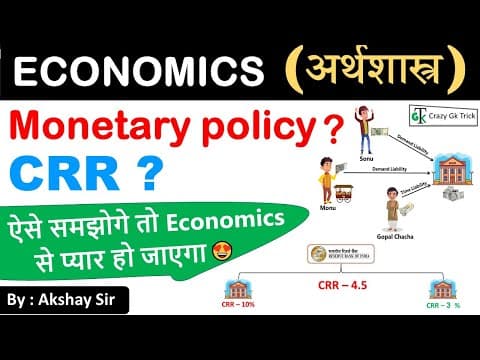
The RBI, established in 1935, is responsible for regulating the banking sector in India. It ensures that banks operate within a framework that promotes financial stability and economic growth. The RBI's regulatory functions include setting the Cash Reserve Ratio (CRR), which is a percentage of a bank's total deposits that must be kept in reserve with the RBI.
To illustrate the concept of CRR, let’s consider a scenario:
The RBI mandates that banks maintain a certain percentage of their net demand and time liabilities (NDTL) as reserves. Currently, this ratio is set at 4.5%. This means that banks must deposit 4.5% of their NDTL with the RBI, ensuring that they have enough liquidity to meet withdrawal demands.
The RBI uses monetary policy to control inflation and stabilize the economy. Here’s how it works:
The formulation of monetary policy in India is carried out by the Monetary Policy Committee (MPC), which consists of six members, including the RBI Governor. The MPC meets every two months to review and set the monetary policy, aiming to keep inflation within a target range of 4% ± 2%.
In summary, monetary policy is a vital tool for managing the economy, and the RBI plays a crucial role in regulating banks and controlling money supply and interest rates. By adjusting the CRR and other monetary policy tools, the RBI aims to maintain economic stability and control inflation, ensuring that the economy functions smoothly.
Understanding these concepts is essential for anyone interested in economics, finance, or business. If you wish to delve deeper into economics, consider exploring dedicated courses that simplify these topics further, making them accessible and understandable for everyone.