This blog post explores the concept of natural selection as proposed by Charles Darwin, detailing its historical context, mechanism, and implications for understanding the interconnectedness of all living organisms. It highlights the beauty of evolution and our responsibility towards all life forms.
The idea of evolution by natural selection is often regarded as one of the most beautiful concepts in biology. This post delves into the history and mechanism of natural selection, its implications for our understanding of life, and the profound connections we share with all living organisms.
The notion that animals and plants evolve is not new. Philosophers like Aristotle speculated about evolution long before it became a widely accepted scientific theory. In the 18th century, various thinkers began to examine fossils and other evidence, suggesting that species had changed over time. However, it was Charles Darwin, during the mid-19th century, who formulated a coherent mechanism for evolution: natural selection.
Darwin's groundbreaking ideas were shaped during a five-year voyage on the HMS Beagle, where he collected numerous specimens of animals, plants, and geological formations. His observations led him to propose that species evolve through a process he termed natural selection, which he published in 1865.
At the core of Darwin's theory is the concept of hereditary material. Although he did not know about genes, he speculated that all living organisms possess some form of hereditary material that can vary. This variability is crucial because it allows certain traits to confer advantages in survival and reproduction.
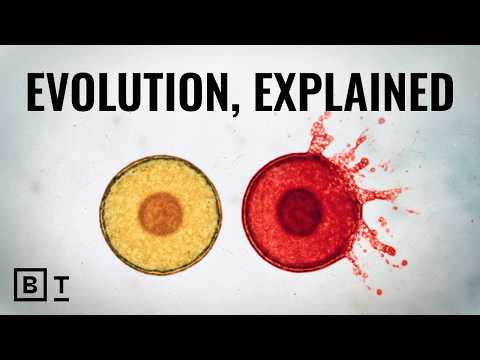
Darwin's idea posits that if a variant of a species has traits that make it better suited to its environment, it is more likely to survive and reproduce. Over generations, these advantageous traits become more common within the population. For example, consider a simple model involving single-celled organisms: if a red-coated organism is more likely to be eaten than a yellow-coated one, a mutation that changes the red coat to yellow would lead to the yellow-coated organisms surviving and proliferating.
Natural selection operates on the principle that advantageous traits are selected for, leading to better-adapted organisms without the need for a designer. This process results in the gradual evolution of species, showcasing the beauty of life’s complexity arising from simple genetic variations.
One of the most significant consequences of evolution is the idea that all living organisms are related by descent. This interconnectedness suggests that every species can trace its lineage back to a common ancestor. The realization of our shared ancestry can be both humbling and enlightening.
Darwin's insights were brought to life for the narrator during a trek through a Ugandan rainforest while observing a family of gorillas. The experience of sitting quietly and making eye contact with a large male gorilla highlighted the deep connections between humans and other life forms. This moment underscored the idea that we share a lineage with these magnificent creatures, having diverged millions of years ago.
If we are indeed related to every living thing on the planet, it raises an important question: do we not have a responsibility to care for all forms of life? This perspective encourages us to act as stewards of the environment, recognizing that every organism, from animals to plants and fungi, is part of our extended family.
The theory of natural selection not only explains the mechanism of evolution but also emphasizes the profound connections we share with all living organisms. Understanding our relationship with nature fosters a sense of responsibility towards the environment and all its inhabitants. As we continue to explore the intricacies of life, let us remember that we are all part of a larger family, interconnected through the threads of evolution.