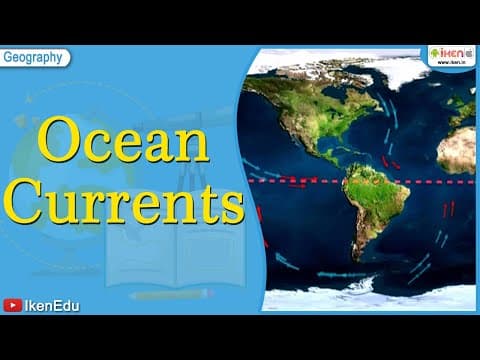
Ocean currents are streams of water that flow in specific directions across the ocean, influenced by wind patterns, temperature differences, and the Earth's rotation. They play a crucial role in climate regulation and marine ecosystems.
Ocean currents are a fundamental aspect of oceanography, representing the third type of movement that occurs in the oceans. These currents are streams of water that flow along the surface of the ocean in defined paths, often extending thousands of kilometers in length and reaching widths of about 200 kilometers. This blog post delves into the nature of ocean currents, their classification, formation, and the factors that influence their behavior.
Ocean currents are more or less permanent streams of water that flow in a definite direction from one part of the ocean to another. They are classified based on their temperature and the regions they originate from:
Ocean currents are typically named after the regions along which they flow. For example, the warm ocean current flowing along the Brazilian coast is known as the Brazilian Current, while the cold current flowing along the Labrador coast is referred to as the Labrador Current.
Ocean currents are primarily powered by the wind systems of the world. The prevailing winds push the surface water of the oceans in specific directions. In general, a surface current of warm, light water flows from the equatorial region towards the polar regions, while a cold current flows from the cold polar regions back towards the warm equatorial region.
The Coriolis effect plays a significant role in the movement of ocean currents. In the northern hemisphere, ocean currents deflect to the right of the wind direction, resulting in a clockwise circulation of water. Conversely, in the southern hemisphere, currents deflect to the left, leading to an anti-clockwise circulation. This phenomenon is caused by the rotation of the Earth.
Temperature differences between the equator and the poles also contribute to the formation of ocean currents. Water near the equator is heated more than that near the poles, creating a density gradient. Warm waters are lighter and move along the surface towards the poles, while cooler, denser waters sink and flow slowly towards the equator. This process is known as convection.
Several factors affect the behavior and characteristics of ocean currents:
Each ocean has its own system of currents, but there are common patterns observed in the Atlantic and Pacific Oceans. Warm equatorial currents typically flow westward and, upon encountering continents, split into two branches: one moving northward and the other southward. As these currents reach higher latitudes, they lose warmth and flow along the western margins of continents as cooler currents.
The currents in the Indian Ocean differ from those in the Atlantic and Pacific Oceans due to the enclosed nature of the sea and the influence of monsoon winds. In the northern part of the Indian Ocean, the direction of the current changes with the seasons. During the summer, when the southwest monsoon blows, the current flows westward. In contrast, during the winter, when the northeast monsoon winds prevail, the current flows eastward.
Ocean currents are vital to understanding the dynamics of our planet's climate and marine ecosystems. They are influenced by a variety of factors, including wind patterns, temperature differences, salinity, and the Earth's rotation. By studying these currents, we can gain insights into weather patterns, climate change, and the health of marine environments.