Output gaps represent the difference between actual and potential output levels in an economy, with negative gaps indicating underperformance and positive gaps indicating overperformance. This blog post explores the definitions, classical and Keynesian interpretations of output gaps, and their implications for economic policy and performance.
Output gaps occur whenever the actual level of output in an economy differs from its potential level of output, which is often referred to as the full employment level of output. This concept is crucial for understanding economic performance and guiding policy decisions.
A negative output gap occurs when the actual output is less than the potential output. This situation is also known as a deflationary gap or a recessionary gap, as it typically arises during periods of economic recession.
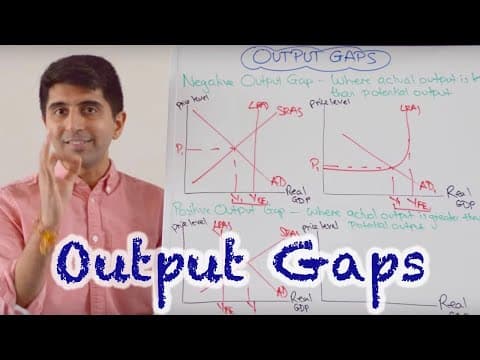
In the classical economic model, we can illustrate a negative output gap using aggregate demand (AD) and short-run aggregate supply (SRAS) curves. The intersection of these curves determines the actual level of output, denoted as Y1, at a price level P1. However, this output level is less than the potential output, represented by the long-run aggregate supply (LRAS) curve, which is positioned to the right of the equilibrium point. The distance between Y1 and the potential output (YF) signifies the negative output gap.
From a Keynesian perspective, the long-run aggregate supply curve also indicates full employment at YF. In this model, if the aggregate demand intersects the LRAS below YF, it again shows that the actual output (Y1) is less than the potential output, confirming the existence of a negative output gap.
Conversely, a positive output gap occurs when the actual output exceeds the potential output. This scenario is often referred to as an inflationary gap.
In the classical model, a positive output gap can be illustrated similarly with AD and SRAS curves. Here, the actual output (Y1) is greater than the potential output (YF), indicating that the economy is producing beyond its sustainable capacity. This situation can arise temporarily when resources are overutilized, leading to an overheating economy and potentially high inflation.
While it is challenging to depict a positive output gap accurately in a Keynesian framework, it can be represented by placing the aggregate demand curve at the upper end of the vertical section of the Keynesian LRAS. This indicates that the economy is operating at or above full employment, resulting in high price levels but not fitting the definition perfectly.
Understanding output gaps is essential for evaluating the effects of shifts in aggregate demand. For instance, if aggregate demand shifts to the right due to an increase in real disposable income, the actual growth may increase. However, if there is a significant negative output gap, the increase in aggregate demand may not lead to inflation, as the economy has room to grow without raising prices.
Conversely, if the economy is near full employment and aggregate demand shifts right, it may lead to inflationary pressures without significant growth or unemployment reduction.
Similarly, when discussing shifts in long-run aggregate supply (LRAS), we typically conclude that such shifts will lead to increased growth and reduced unemployment. However, if there is a substantial negative output gap, a shift in LRAS may not result in any changes in equilibrium if aggregate demand is insufficient to meet the new supply level. In such cases, demand-side policies are necessary to stimulate the economy rather than relying solely on supply-side policies.
Output gaps are a vital tool for evaluating economic performance and guiding policy decisions. By understanding the implications of negative and positive output gaps, economists and policymakers can better navigate the complexities of economic growth, inflation, and unemployment. This understanding is crucial for crafting effective responses to varying economic conditions and ensuring sustainable growth in the long run.