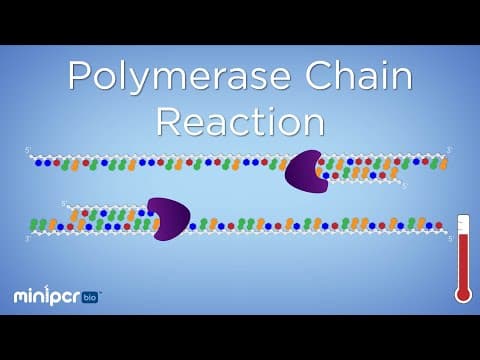
PCR, or Polymerase Chain Reaction, is a crucial laboratory technique that allows scientists to amplify specific DNA sequences, enabling advancements in genetics, disease diagnosis, and more. This blog post explores the steps of PCR, its components, and its applications in various fields.
We live in a moment where genetics is helping us understand more and more of the world around us, from untangling evolutionary histories to more precisely diagnosing and treating disease. To achieve these advancements, we need to find and examine specific pieces of DNA. One of the fundamental tools used for this purpose is called PCR, or Polymerase Chain Reaction. In this article, we will explore this important laboratory technique in detail.
PCR is a method used to amplify specific DNA sequences, making it easier to study and analyze genetic material. Imagine the human genome, which contains 3.2 billion base pairs. Identifying just one genetic sequence, which may be only a few hundred bases long, out of this vast genome can be likened to searching for a needle in a haystack. PCR acts as a tool that finds that needle and makes numerous copies of it, resulting in a large quantity of the target DNA sequence.
To understand how PCR works, it is essential to know that DNA is composed of two complementary strands that form a double helix. An adenine (A) on one strand will always bind to a thymine (T) on the other, while a cytosine (C) pairs with a guanine (G). This complementary nature allows scientists to replicate one strand if they know the sequence of the other.
PCR consists of three main steps: Denaturation, Annealing, and Extension. These steps are repeated multiple times to amplify the DNA.
The first step, called denaturation, involves separating the two strands of the DNA sample, referred to as the template DNA. This is achieved by heating the DNA to approximately 95 degrees Celsius, which breaks the hydrogen bonds between the strands. After an initial longer denaturation period, each cycle typically requires only a short denaturation of around 10 seconds.
In the second step, we specify the region of DNA to be amplified using short pieces of DNA called primers. Each PCR reaction uses two types of primers: forward and reverse. The forward primer matches a sequence at the beginning of the target region, while the reverse primer matches the end of the region on the opposite strand. Primers are usually around 20 bases long.
When the reaction cools down, the primers anneal to their complementary regions on the template DNA. The annealing temperature typically ranges from 50 to 65 degrees Celsius, depending on the specific length and sequence of the primers. This step usually lasts between 5 to 30 seconds.
The final step is extension, where the DNA is copied. This is facilitated by an enzyme called DNA Polymerase, which is the “P” in PCR. The polymerase binds to the ends of the double-stranded regions where the primers have attached and moves along the DNA, adding the correct complementary nucleotides. For example, if it encounters a C on the template strand, it adds a G, and so forth.
The extension step typically occurs at around 72 degrees Celsius, the optimal temperature for the polymerase. The duration of this step can vary; longer target sequences require more time for copying, while shorter sequences may only need a few seconds.
To withstand the high temperatures used in PCR, we utilize a special polymerase known as Taq Polymerase. This enzyme was originally discovered in thermophilic bacteria found in the hot springs of Yellowstone National Park and remains stable throughout the heating and cooling cycles of PCR.
All these steps occur in a machine called a thermal cycler. In this case, we are using a miniPCR machine from miniPCR bio. The DNA, along with all necessary ingredients, is placed in tubes and inserted into the thermal cycler, which heats and cools the samples according to the specified program.
After one cycle of denaturation, annealing, and extension, we have transformed our original piece of target DNA into two copies. This cycle is repeated multiple times, exponentially amplifying the DNA. Most PCR processes run for around 30 cycles, resulting in approximately 1 billion copies of the original target sequence.
For PCR to work effectively, the right ingredients are crucial. Here’s what is typically included in each tube:
The applications of PCR are vast and varied. After completing the PCR process, the new DNA copies can be used for several purposes:
The ability to create billions of copies of a specific DNA sequence has made PCR a staple in molecular biology laboratories for decades. It allows researchers, students, and scientists to investigate DNA in various contexts.
miniPCR thermal cyclers have made PCR more accessible to users worldwide, from classrooms to remote field stations and even space missions. This powerful technique continues to revolutionize our understanding of genetics and its applications in science and medicine.