
This blog post explains Polymerase Chain Reaction (PCR), a crucial technique in biotechnology for amplifying DNA. It covers the process, reagents involved, and its applications in forensics, agriculture, and medicine, particularly in COVID-19 testing.
Welcome to the fascinating world of Polymerase Chain Reaction (PCR), a pivotal technique in biotechnology that has transformed various fields, including medicine, forensics, and agriculture. In this post, we will explore what PCR is, how it works, the reagents involved, and its significant role in COVID-19 testing.
PCR, or Polymerase Chain Reaction, is a method used to amplify small segments of DNA, making millions to billions of copies from a tiny sample. This process mimics natural DNA replication, allowing scientists to study and analyze genetic material more effectively. Often referred to as "molecular photocopying," PCR enables exponential growth of DNA copies, which is essential for various applications in biotechnology.
PCR is utilized across multiple industries:
In forensic science, PCR is instrumental in amplifying genetic material from crime scenes. This allows investigators to compare DNA samples from unknown sources to those of suspects or databases, significantly aiding in solving crimes.
PCR plays a crucial role in agriculture, particularly in plant genotyping. It helps in breeding programs by identifying desirable traits and determining whether specific plants should be cloned.
In the medical field, PCR is a vital diagnostic tool. It is used for genetic testing, tracking cancer mutations, and notably, in COVID-19 testing.
To perform PCR, several key reagents must be combined:
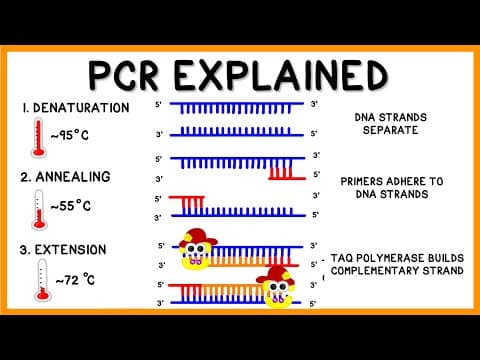
PCR consists of three main steps: denaturation, annealing, and extension. These steps are repeated in cycles, doubling the amount of DNA with each cycle.
During this phase, the DNA is heated to approximately 95 degrees Celsius, breaking the hydrogen bonds between the strands and creating two separate template strands.
The temperature is lowered to about 55 degrees Celsius, allowing primers to bind to their complementary sequences on the template strands. The presence of magnesium ions is crucial here, as they help stabilize the binding of primers.
At around 72 degrees Celsius, Taq Polymerase synthesizes new DNA strands by adding DNTPs to the primers, effectively doubling the amount of DNA. This cycle repeats multiple times, leading to exponential amplification of the target DNA sequence.
With the emergence of the COVID-19 pandemic, PCR testing has gained widespread recognition. A modified version of PCR, known as RT-qPCR (Reverse Transcription Quantitative PCR), is used to detect the presence of the SARS-CoV-2 virus.
RT-qPCR is highly accurate, with false positives being rare. However, false negatives can occur, particularly if a sample is taken too early in the infection when viral RNA levels are low.
PCR is a revolutionary technique that has significantly impacted various fields, particularly in diagnostics and research. Its ability to amplify DNA has made it an indispensable tool in modern science, especially during the COVID-19 pandemic. Understanding the intricacies of PCR not only highlights its importance but also showcases the remarkable advancements in biotechnology that continue to shape our world.



















